
Introduction
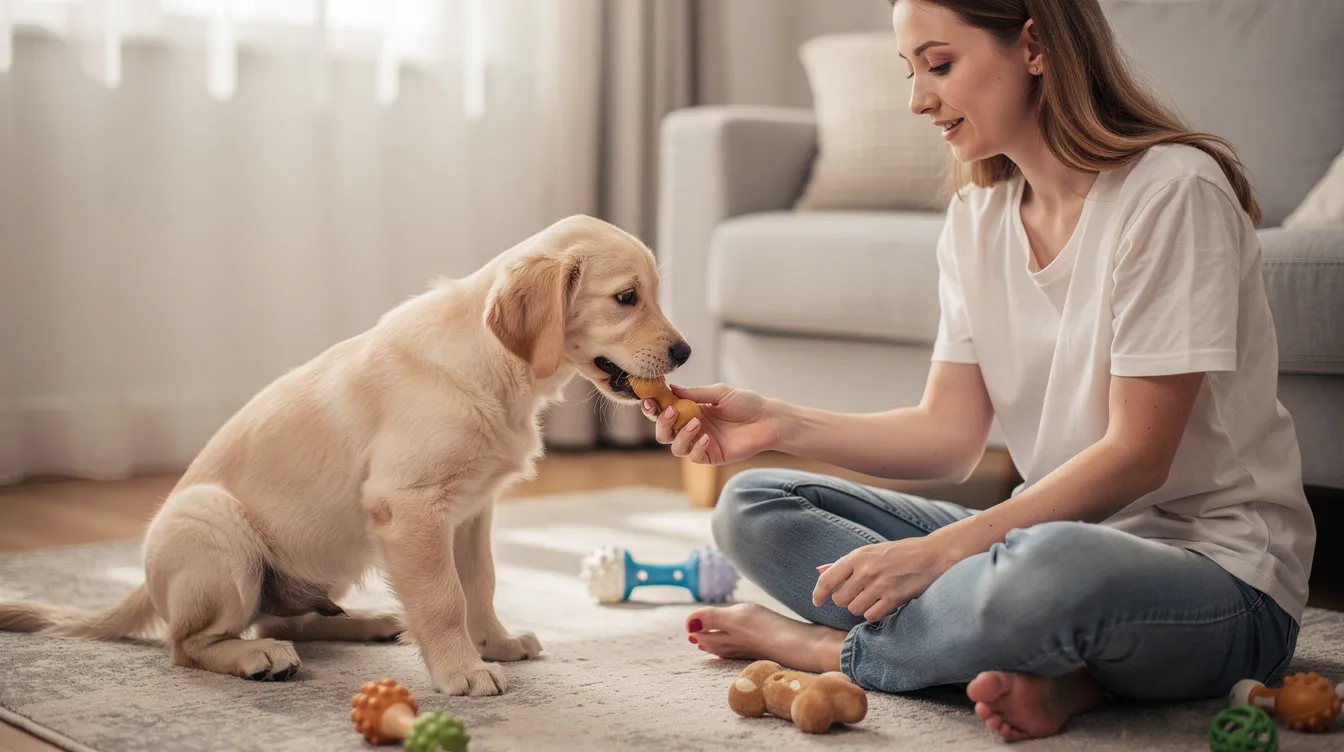
Puppy biting is a normal part of development, not a sign that something is wrong with your dog. Those needle-sharp teeth can make even gentle mouthing feel painful, but the good news is that puppy biting and nipping respond remarkably well to consistent, structured training. With the right approach, most dog owners see clear improvement within just a few weeks.
This guide covers normal developmental mouthing and biting in puppies aged 8 weeks to 6 months-the period when teething, social play, and oral exploration are at their peak. It is written specifically for Phoenix area families dealing with puppy mouthing, play biting, and teething-related nipping. If your puppy displays stiff body posture, baring teeth with intent, resource guarding, or causes puncture wounds, that falls outside normal developmental biting behavior and may require a professional behavior assessment.
Puppy biting can be stopped through consistent bite inhibition training, redirection to appropriate chew toys, and structured timeout systems-typically producing measurable results within 2–4 weeks of daily practice.
By the end of this guide, you will:
- Understand exactly why puppies bite and how to distinguish normal from problematic behavior
- Master bite inhibition techniques that teach your puppy a soft mouth
- Implement effective redirection strategies using the right toys and timing
- Know precisely when it’s time to seek professional help from a certified dog trainer
Understanding Puppy Biting Behavior
Puppy mouthing, nipping, and biting are natural behaviors that serve critical developmental functions. Puppies explore their world primarily through their mouths-they don’t have hands, so those sharp puppy teeth become their primary tool for investigating textures, communicating during play, and learning social boundaries. Understanding these behaviors is the first step toward changing them.
Why Puppies Bite and Nip
There are several core reasons many puppies engage in mouthing and biting during their first months of life:
Teething discomfort is one of the most common drivers. Puppies begin teething at around 3 weeks old, with all baby teeth present by roughly six weeks. Puppies lose their baby teeth around 12 weeks old, and permanent adult teeth usually emerge by 7 months of age. Teething discomfort peaks between 3 to 6 months of age, and puppies may chew more when teething to relieve discomfort. This teething phase drives much of the intense chewing and mouthing behavior owners experience.
Exploration and investigation account for a significant portion of puppy nipping. Puppies use their mouths to explore their environment in the same way human toddlers use their hands-grabbing, testing, and tasting everything within reach. When a puppy grabs your sleeve or mouths your fingers, it’s often simply gathering information about the world.
Play behavior is deeply tied to biting. Puppies play by wrestling, chasing, and mouthing each other. Among littermates, puppies engage in rough play that teaches them how hard they can bite before a sibling yelps and stops playing. When puppies come home to human families, they naturally try the same lesson with their new companions.
Attention-seeking and overstimulation also encourage biting. Biting can indicate excitement or a need for attention, and overstimulation can lead to excessive biting during play. A young dog that’s been riled up beyond their ability to self-regulate will often escalate from gentle mouthing to harder nips.
The critical takeaway is that these are normal behaviors that require guidance, not punishment. Physical punishment can create fear or aggression in puppies and typically worsens the very behavior you’re trying to stop.
Normal vs Problematic Biting
Distinguishing normal mouthing from aggressive biting helps you choose the right response.
Normal puppy mouthing features soft pressure on human skin, a relaxed body posture, playful bouncing, pawing, and a willingness to stop when corrected. In a U.S. survey (Waite et al., 2021), over 80% of dogs under one year displayed mouthing behavior. Playful biting and gentle mouthing are extremely common and tend to decrease with age and training; puppy biting typically decreases by seven months of age, and puppies typically stop biting by 8 to 10 months old.
Problematic or aggressive biting looks distinctly different. Watch for hard pressure that breaks skin, stiff body language, growling or snarling, and biting connected to resource guarding or fear. If your puppy’s biting arises from frustration or fear rather than play, or if it continues with increasing intensity past six months, this is a potential problem behavior that may require intervention from a certified behaviorist.
Normal biting responds to the training techniques covered below, while aggressive biting typically requires a professional consultation to address underlying behavioral issues safely.
Immediate Training Techniques
Now that you understand why puppies bite and what constitutes normal behavior, here are three proven methods professional dog trainers use to stop puppy biting effectively. These techniques work best in combination-and all rely on positive reinforcement and reward-based training rather than punishment.
Bite Inhibition Training
Bite inhibition is the ability to control bite force-it’s not about eliminating all mouth contact, but about teaching bite inhibition so your puppy develops a reliably soft mouth. Puppies learn bite inhibition from their mother and littermates: when a puppy bites a sibling too hard, the sibling yelps and stops playing, delivering an immediate consequence. You can replicate this natural feedback system.
Using a high-pitched yelp teaches puppies to control their bites. When your puppy delivers a hard bite, let out a sharp, high-pitched “OUCH!” and immediately go limp, withdrawing your hand. Stop play for 10–15 seconds. This mimics the response a littermate would give. If your puppy releases and mouths gently, resume play as a reward for gentle behavior.
The key to teaching bite inhibition is gradual pressure reduction. In the first week, only react to the hardest bites. Over subsequent weeks, react to progressively softer bites until your puppy learns to mouth gently or not at all. Bite inhibition training requires patience and consistency-every family member must respond identically to biting incidents. If one person yelps and enforces timeouts while another laughs and continues playing, the puppy receives mixed signals that undermine progress.
Puppies without early social groups may lag in developing puppy bite inhibition. Recent research suggests breeders should begin bite prevention through early body handling and object exchange before puppies leave for their new homes. Enrolling your puppy in a good puppy class with vaccinated adult dogs and age-appropriate playmates can help fill that developmental gap.
Redirection Methods
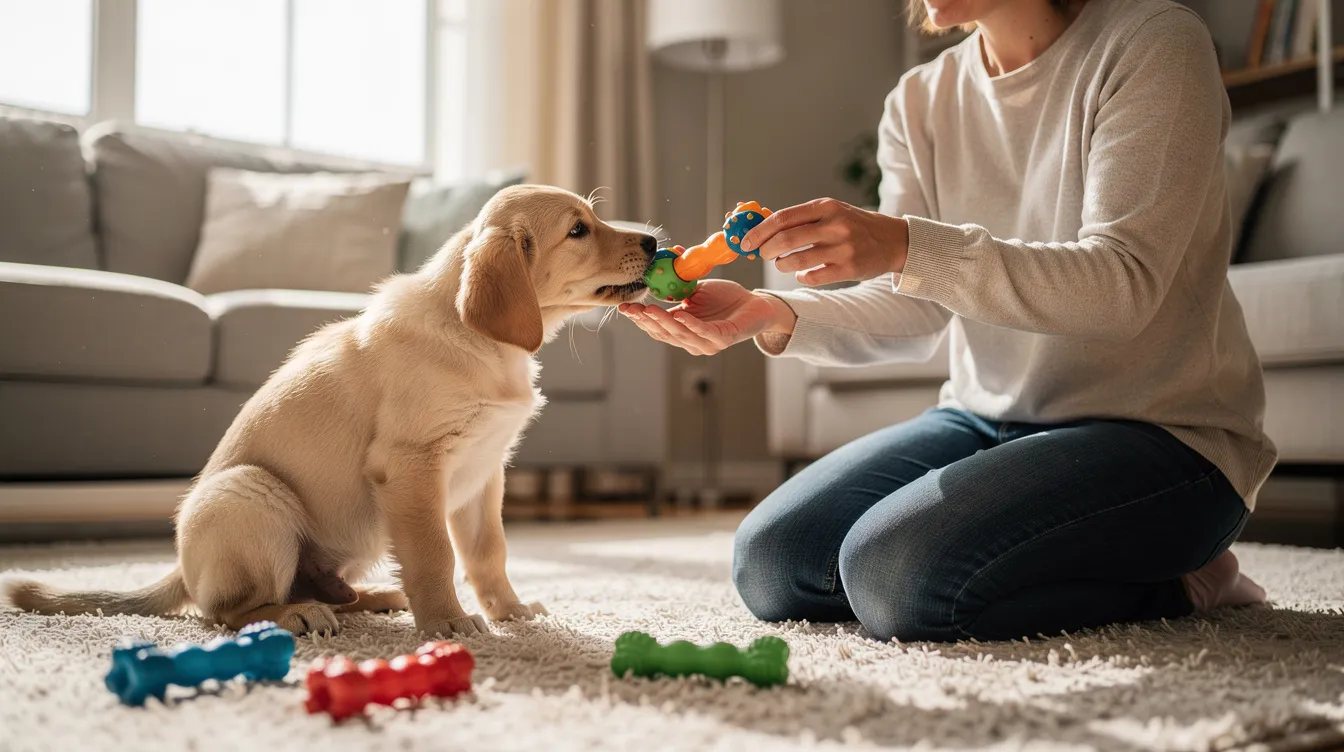
Redirection is one of the fastest ways to reduce biting-redirect biting to chew toys to teach appropriate behavior. The moment a puppy grabs your hand, sleeve, or pant leg, calmly remove the body part and immediately offer an appropriate alternative. Using toys instead of hands during play helps prevent biting from becoming a reinforced habit.
Effective redirect toys include:
- Textured rubber chews that satisfy the urge to gnaw during teething
- Rope toys and tug toys that channel rough play energy into acceptable outlets
- Frozen Kong toys filled with treats that provide both physical and mental stimulation while soothing sore gums
- Puppy-safe chews designed specifically for young puppies with developing teeth
Timing matters enormously. Redirect biting to appropriate chew toys during play before the mouthing escalates-when you see your puppy’s excitement building, proactively offer a chew toy rather than waiting for teeth to connect with skin. When the puppy releases your hand and accepts the toy, immediately praise or reward the choice. Keep chew toys rotated to maintain interest for puppies, as novelty increases engagement.
Never use your hands, fingers, or feet as play objects. This directly teaches puppies that human skin is an acceptable target and will encourage biting rather than discourage it.
Time-Out Systems
Using reverse time-outs can effectively teach puppies that biting ends interaction. When redirection and yelping don’t stop the biting, a brief time-out removes the thing your puppy wants most: your attention.
Ending playtime immediately after biting teaches consequences. Here’s how to implement it effectively:
- When biting persists after redirection, say “too bad” in a neutral tone
- Withdraw all attention-stand up, cross your arms, turn away, or leave the room entirely
- Keep the timeout brief: 30–60 seconds is sufficient for young puppies
- Use safe timeout locations behind baby gates or in puppy-proofed areas
- Resume interaction calmly only when the puppy lets go and settles
The critical detail: remove yourself rather than physically moving the puppy. Walking away is more powerful than pushing a puppy into a pen, because it clearly communicates that biting ends the fun. Ending playtime teaches puppies that biting is unacceptable far more effectively than any verbal correction.
Advanced Training Strategies and Implementation
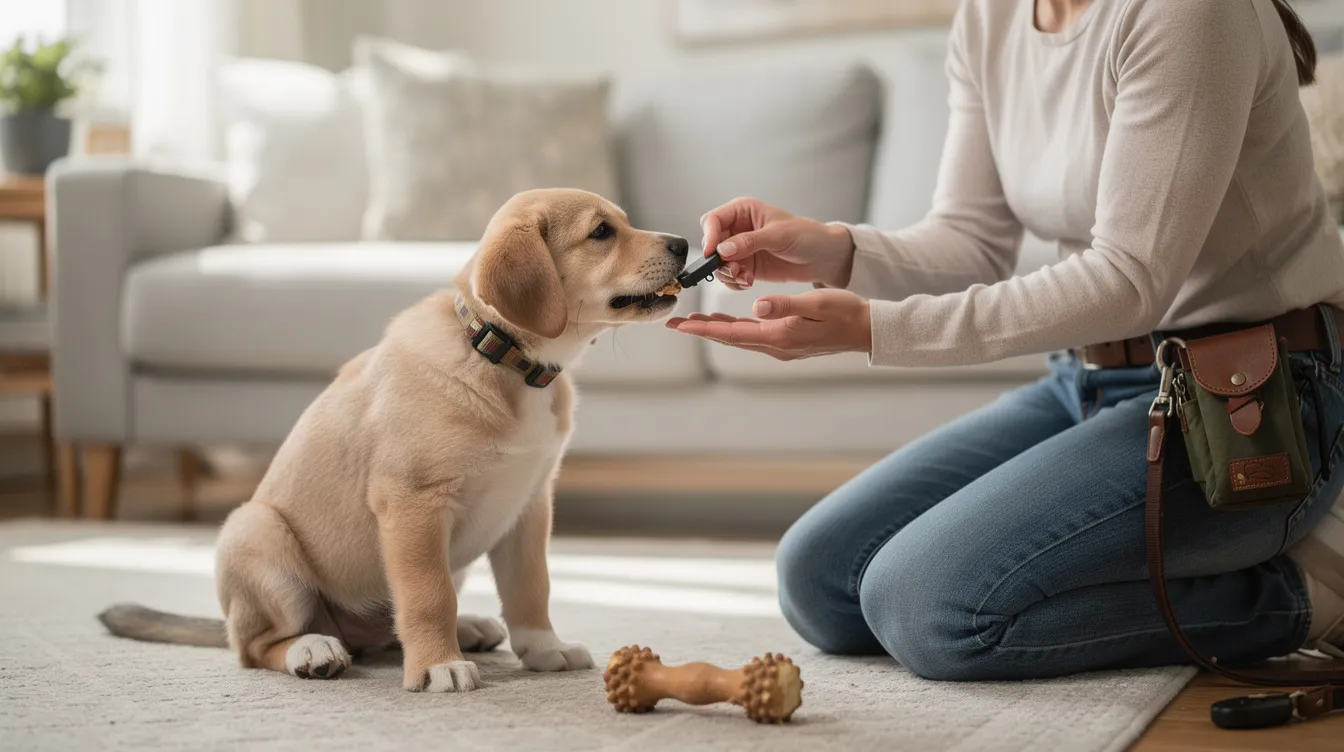
With the core techniques established, a structured puppy training program helps you apply them systematically and track measurable progress over time.
Step-by-Step Training Process
This four-week program builds skills progressively. Puppies need consistent boundaries to prevent biting habits from solidifying.
- Week 1: Establish baseline and begin bite inhibition. Track how often your puppy bites, how hard, and in what contexts. Start the yelp response for the hardest bites only. Redirect all mouthing to chew toys. Remove hands as play objects entirely. Manage the puppy’s environment to minimize access to temptation zones-shoes, dangling cords, clothing.
- Week 2: Tighten bite pressure criteria. React to progressively softer bites. Enforce time-outs consistently when biting persists after redirection. Praise your puppy generously for choosing toys over skin. Rewarding calm behavior can help reduce biting tendencies in puppies. Begin requiring your puppy to mouth gently before play continues.
- Week 3: Build impulse control. Add basic training commands like “sit” and “wait” before play sessions begin-basic training commands enhance a puppy’s impulse control and behavior. Practice controlled fetch and structured tug games that teach your puppy to release on cue. Increase distractions gradually. Provide mental stimulation through puzzle feeders and training games to drain excess energy that might otherwise fuel biting.
- Week 4: Reinforce and generalize. Focus on remaining problem areas-specific family members, high-excitement scenarios, or particular times of day. Test bite inhibition in new environments (yard, walks, social settings). By this point, you should see a measurable reduction in both bite frequency and bite pressure.
Positive reinforcement helps puppies learn to stop biting faster than any correction-based method. Marker training techniques can accelerate this process by clearly communicating which behaviors earn rewards.
Training Method Comparison
| Method | Effectiveness | Time to Results | Best Used For |
|---|---|---|---|
| Bite Inhibition | High | 2–3 weeks | Teaching bite pressure control and developing a soft mouth |
| Redirection | Very High | 1–2 weeks | Immediate behavior management and channeling energy playing |
| Timeouts | Moderate | 3–4 weeks | Persistent mouthing issues and attention-seeking biting |
| Combined Approach | Highest | 2–4 weeks | Comprehensive unwanted behavior elimination |
No single method works perfectly in isolation. Redirection alone doesn’t address underlying over-arousal. Timeouts lose effectiveness if other family members still provide attention. Bite inhibition without socialization among other puppies may limit how well the dog’s ability to generalize carries over to new situations. Combining all three methods typically yields the best outcomes, and the right mix depends on your puppy’s temperament, breed, age, and household structure. “Mouthy” breeds like retrievers and herding dogs, for instance, may need heavier emphasis on redirection with durable chew toys.
Common Challenges and Solutions
Even with the best techniques, most puppies present specific challenges that can stall progress. Here are the most common obstacles Phoenix area dog owners encounter-and how to overcome them.
Puppy Bites Harder During Timeouts
Some puppies escalate biting when they sense attention is being withdrawn. Remove yourself completely from the puppy’s reach using baby gates or leaving the room entirely. The puppy must learn that a hard bite causes you to vanish, not just turn away within grabbing distance. If your puppy is in a pen, step out of sight completely for 30–60 seconds.
Multiple Family Members Getting Different Results
Inconsistent responses are the single biggest obstacle to stopping puppy nipping. If one person yelps and enforces timeouts while another wrestles with the puppy using their hands, the puppy learns that biting works with some people. Establish a household rules document and ensure all family members use identical responses to biting incidents-the same yelp, the same redirection, the same timeout protocol.
Puppy Only Bites Certain Family Members
Some puppies target specific people-often children, visitors, or less confident handlers. The target person should lead all training exercises and provide high-value treats to rebuild positive association. Have that person practice gentle play and reward-based training sessions independently, gradually building the puppy’s association between that person and calm, rewarding interactions.
Biting Increases During Evening Hours
If your young dog turns into a biting machine every evening, overtiredness is almost certainly the cause. Puppies require 16 to 20 hours of sleep per day to avoid biting behaviors. Implement structured nap schedules throughout the day-puppies should have regular nap times for better behavior management. An overtired puppy lacks the self-control to respond to training. Avoid late-evening play sessions, and use a crate or quiet space for enforced rest before the “witching hour” hits.
No Improvement After 4 Weeks of Training
If four weeks of consistent, daily training produces no measurable improvement in bite pressure or frequency, two things need to happen. First, schedule a veterinary exam to rule out medical causes-oral pathology, pain, or other issues can exacerbate biting behavior. Second, consult a certified professional dog trainer for personalized assessment. A behavior modification program may be appropriate for puppies that don’t respond to standard techniques, especially as the puppy grows into an older, larger big dog where uncontrolled biting poses greater risk.
As your puppy grows into adolescence, new behavioral challenges often emerge. Understanding why adolescent dogs misbehave can help you maintain training momentum past the initial puppy stage.
Conclusion and Next Steps
Puppy biting is a normal part of development-not a sign of a bad dog or a future aggressor. Most puppies stop biting with consistent application of bite inhibition training, redirection to appropriate toys, and structured timeouts. The key variables are consistency, patience, and household-wide commitment to the same approach. Puppies engage with these methods quickly when every interaction reinforces the same lesson: gentle behavior continues play, and biting ends it.
Start today with these immediate steps:
- Stop using your hands as play objects and stock up on appropriate chew toys, tug toys, and puppy-safe chews
- Begin bite inhibition training by yelping only on the hardest bites, then gradually tightening criteria
- Establish household rules so every family member responds identically to biting
- Track your puppy’s biting frequency and intensity daily to measure progress over 2–4 weeks
- Ensure your puppy gets adequate sleep and both physical and mental stimulation throughout the day
If you need personalized guidance, Off Leash K9 Training Phoenix offers free phone consultations to assess your puppy’s biting severity, discuss breed-specific considerations, and recommend a tailored training plan for your household.
Additional Resources
- Professional puppy training: Off Leash K9 Training Phoenix provides structured puppy training programs that include bite inhibition modules, impulse control work, and distraction-proof obedience training
- Board and train options: For families needing accelerated results, the 2-week board and train program provides intensive daily training with measurable outcomes
- Bite prevention education: Learn more about long-term safety with muzzle training and dog bite prevention strategies as your puppy matures
- Teething supplies: Rotate between frozen Kongs, textured rubber chews, and rope toys to keep your teething puppy engaged with appropriate items rather than furniture and fingers
- Puppy classes: Enroll in local puppy socialization classes where young puppies can practice alternative behaviors and learn bite inhibition from age-appropriate playmates and vaccinated adult dogs
