
Introduction
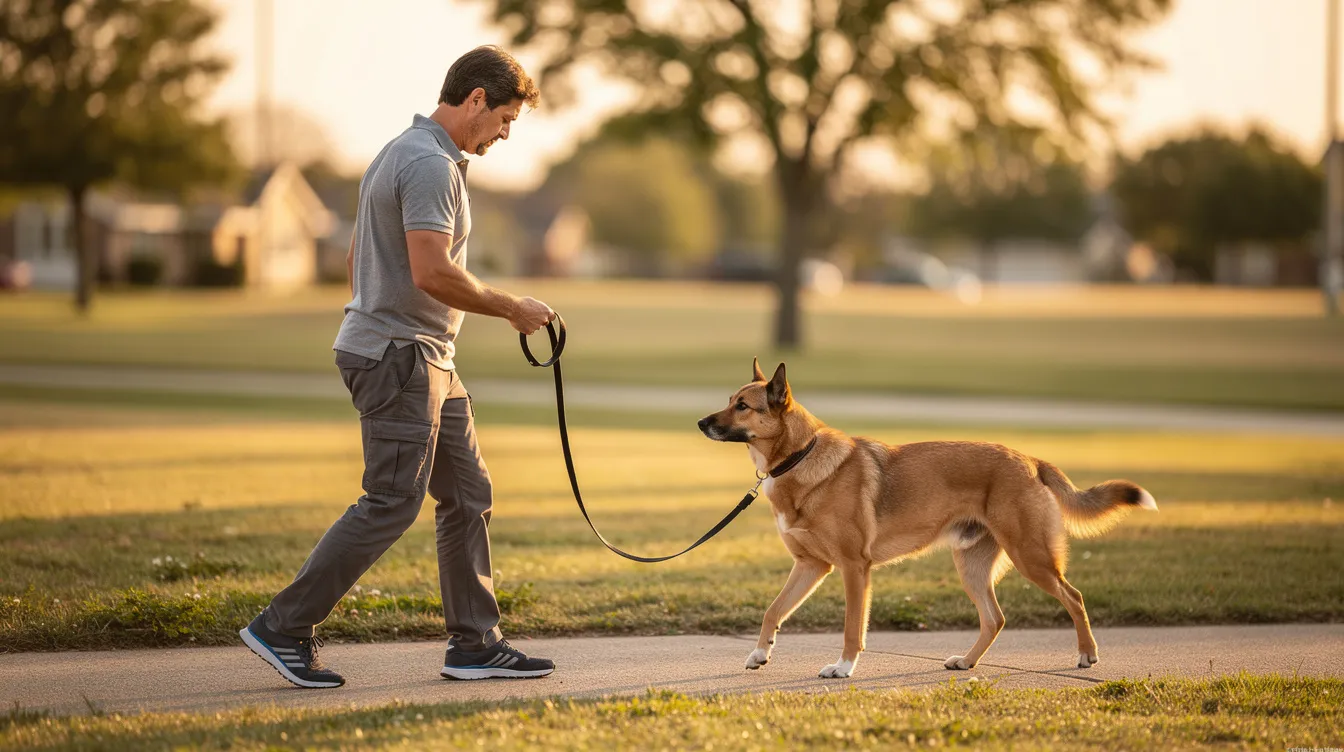
Loose leash walking means your dog walks beside you-or at least nearby-with visible slack in the leash, no pulling, and consistent attention to your cues. It is one of the most requested and most misunderstood skills in dog training, and mastering it transforms every walk from a frustrating tug-of-war into a genuinely enjoyable experience for both you and your dog.
This guide covers everything from foundational concepts to advanced techniques for dogs of every age and breed. Whether you’re working with a puppy just learning the leash, an adult dog with an ingrained pulling habit, or a rescue dog adjusting to a new life and new space, the methods here apply. It’s written with Phoenix-area dog owners in mind-those dealing with urban distractions, desert heat scheduling, and the goal of building toward reliable off-leash control.
The direct answer: Loose-leash walking can be taught using positive reinforcement and clear boundaries. It requires consistent training across multiple skills-impulse control, attention, response to leash pressure, and environmental awareness-practiced in simple steps and gradually proofed against distractions.
By the end of this guide, you will:
- Understand exactly why your dog pulls and what drives the behavior
- Know how to select the right equipment and training environment
- Follow a proven step-by-step method to teach loose leash walking
- Troubleshoot the most common challenges that stall progress
- Build a foundation for advanced obedience, including off-leash training and reliable recall
Understanding Loose Leash Walking Fundamentals
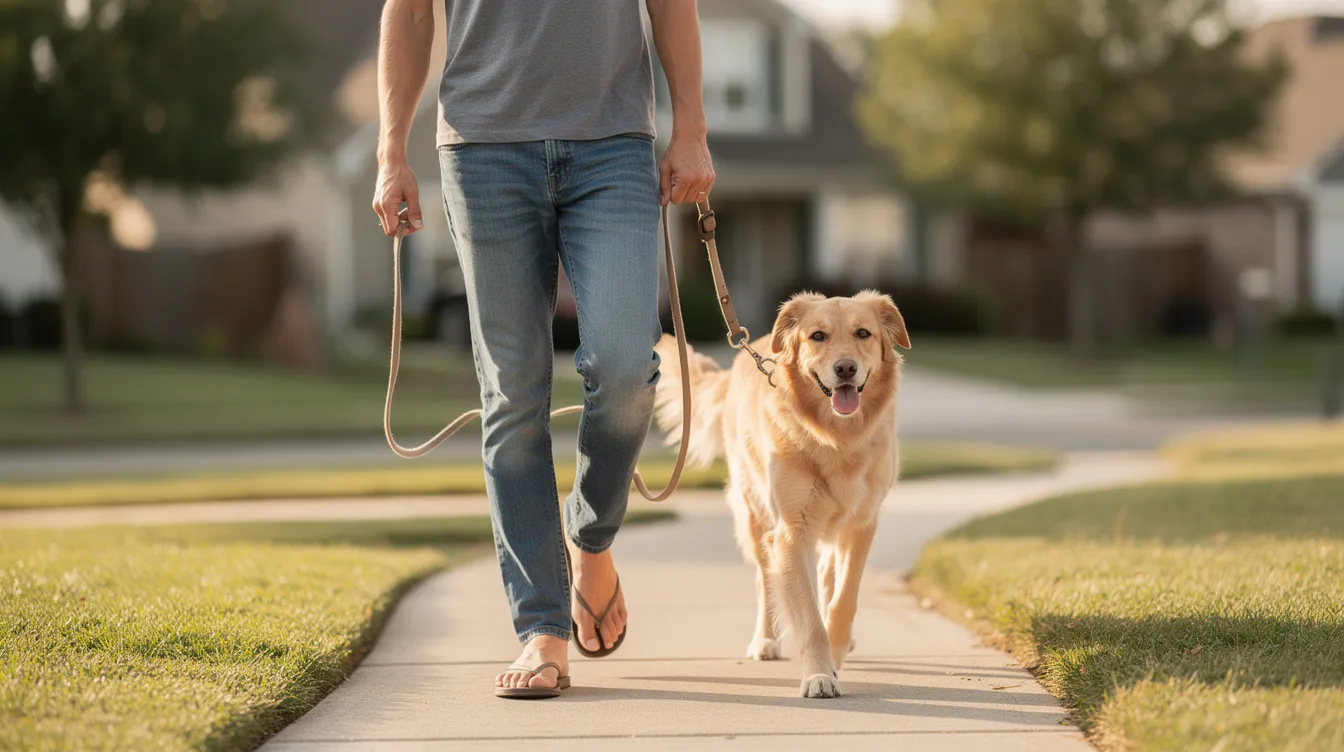
Loose leash walking is the skill of your dog walking with slack in the leash while you maintain safety, control, and effective communication. The leash hangs in a relaxed “J” shape-no leash tension pulling your arm forward, no dog straining at the end of the line. It doesn’t mean your dog is glued to your side in a rigid heel; it means the dog decides to stay within leash range, checks in with you regularly, and responds when you change directions or pace.
This skill is foundational to everything else in obedience. At Off Leash K9 Training Phoenix, loose leash walking is treated as a prerequisite for distraction-proof obedience and eventual off-leash freedom-because a dog that can’t manage itself on a leash will struggle even more without one.
The Psychology Behind Pulling
Pulling on a leash isn’t disobedience. It’s normal canine behavior. Dogs evolved to explore through smell-dogs have up to 300 million olfactory receptors for scent detection, and their nose drives much of their decision-making on a walk. They naturally move at a faster pace than most humans, and they’re wired to investigate stimuli: other dogs, food scraps on the ground, squirrels across the street. Dogs learn to pull when they are tempted by distant smells or interesting sights and discover that leaning into the leash gets them closer to what they want.
The core issue is impulse control. Research published in Physiology & Behavior has linked impulsivity in dogs to neurological factors including lower serotonin metabolite (5-HIAA) levels and dopamine system involvement, meaning some dogs are biologically predisposed to struggle more with restraint. Breed matters too-working lines tend toward higher trait impulsivity than show lines.
Critically, a meta-analysis of impulsivity tasks found that out of 31 pairs of impulse-control tasks studied, 28 showed no correlation. A dog who can “sit-stay” perfectly in the kitchen may still lunge at a squirrel on the street. This means you must train leash-specific behaviors in leash-specific contexts-don’t expect a great “leave it” indoors to automatically fix outdoor pulling.
Benefits of Proper Leash Training
Physical benefits: You experience less shoulder and arm strain. Your dog avoids neck injuries common with choke chains and prong collars under tension. Better walks lead to more consistent, longer exercise-improved cardiovascular health for both of you.
Behavioral benefits: Dogs who walk well on leash show increased attention to their handler, stronger response to commands, and lower stress around distractions. Loose leash walking teaches impulse inhibition, improves focus, and creates a platform for advanced skills. Many dogs that master leash walking transition more smoothly to off-leash training because the underlying attention and control skills are already in place.
Welfare outcomes: A multi-study review in the Journal of Veterinary Behavior found no evidence that aversive methods are more effective than positive reinforcement, and a significant risk of negative emotional and behavioral outcomes when punishment-based tools are used. Dogs walking with a loose leash experience reduced anxiety, and the training process itself strengthens the bond between dog and owner.
With these fundamentals clear, the next step is selecting the right equipment and environment to set your training up for success.
Essential Equipment and Training Setup
The best training method in the world won’t work if your equipment fights against you or your environment overwhelms your dog. Getting setup right is half the battle.
Choosing the Right Leash and Harness
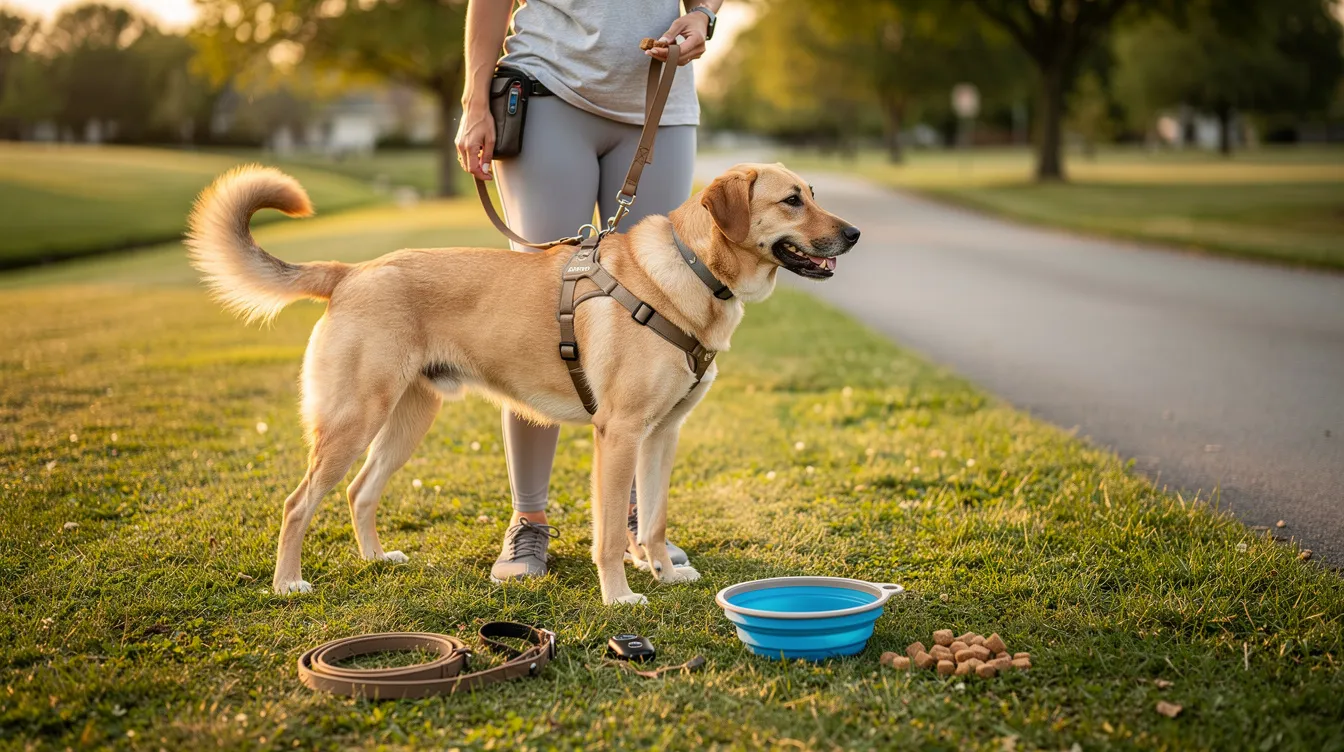
Standard 6-foot leash: A 6-foot leash is commonly recommended for training sessions. It provides enough room for your dog to move naturally while keeping you close enough to communicate through gentle leash pressure and deliver treats at your hip. Flat, non-retractable designs are essential-retractable leashes are not suitable for effective leash training because they teach dogs that pulling extends their range, which is exactly the opposite of what you want.
Longer leashes: Using a longer leash can reduce pulling behavior. A long line of 10-15 feet works well in open, low-distraction areas during early phases, giving the dog room to explore without constant tension. Longer leashes allow dogs to sniff more during walks, which fulfills behavioral needs. However, a long leash should be used deliberately-if you let a long line become a tool for the dog to simply pull at greater distance, it reinforces the wrong behavior.
Harnesses: Non-restrictive harnesses are recommended for leash training. Front-clip harnesses help manage pulling behavior effectively by redirecting forward momentum toward the handler, making it mechanically harder for the dog to lean and drag. Back-clip harnesses work fine for dogs that already walk well or for running, but they offer less control for strong pullers.
What to avoid: Avoid using choke or prong collars during positive reinforcement training. These tools carry a risk of physical harm to the dog’s neck and trachea, and research consistently shows they don’t outperform reward-based methods while posing significant welfare concerns. Head collars like the Gentle Leader can be effective but require careful fitting and acclimation-consider professional guidance if using one.
Training Environment Selection
Start leash training in a low-distraction area like your house or backyard. Inside your house, you can practice basic leash pressure response, name recognition, and initial walking patterns without competing against the entire sensory world. A quiet street or a calm corner of a Phoenix residential neighborhood works as the next step.
Gradually increase distractions from quiet to busier environments during training. Move from your backyard to a quiet park, then a busier park, then a street with foot traffic. Each new environment is a new space where your dog needs to re-learn the same skills under greater pressure. Phoenix offers an excellent gradient: quiet suburban blocks, moderately busy neighborhood parks, and high-stimulation areas like downtown or busy trailheads.
Timing and Consistency Requirements
Training sessions should be kept short to maintain your dog’s focus. Five to ten minutes, two to three times per day, is far more effective than a single 45-minute session that exhausts both you and your dog. For puppies in the 8-16 week socialization window, even shorter sessions of 3-5 minutes work best.
Consistency among all family members is non-negotiable. If one person rewards loose leash walking and another lets the dog pull them down the street, progress stalls. Everyone who walks the dog must follow the same rules: reward slack, stop for tension, and reinforce the same behaviors.
With your equipment selected and environment planned, you’re ready to start the actual training process.
Step-by-Step Training Methods
Loose leash walking requires teaching multiple skills to both dog and handler. It’s not a single trick-it’s a collection of behaviors that work together. The following method breaks it down into six learnable skills, practiced in sequence and then combined.
The Six Essential Skills Method
Use this comprehensive approach for any dog-puppy, adult dog, or rescue dog-adjusting treat value and session length to your dog’s needs.
- Name recognition and eye contact training. Say your dog’s name. The instant the dog looks at you, mark (with a clicker or verbal “yes”) and treat. Practice this in your house first. When the dog reliably snaps their head toward you at the sound of their name-making eye contact within 1-2 seconds-you have the foundation for everything else. Reinforce check-ins with treats during walks to keep your dog mentally connected throughout.
- Teaching response to leash pressure. Clip the leash on indoors. Apply very gentle leash pressure to one side-not a jerk, just light tension. The moment the dog moves toward the pressure (releasing it), mark and treat. Mark and treat when the dog releases leash tension. This teaches the dog that leash pressure is information, not something to fight against. Gradually build up the number of steps before rewarding during leash training.
- Building check-in behavior. Stand quietly with your dog on leash in a low-distraction area. Do nothing. Wait. When the dog checking in-glancing back at you, turning their head, or moving toward you-mark and treat immediately. Reinforce check-ins to keep your dog mentally connected. You’re rewarding the dog’s choice to pay attention to you without being asked. This is the skill that makes leash walking sustainable over time.
- The circle method for impulse control and redirection. When the dog starts pulling toward something, change directions. Don’t yank-simply turn and start walking the other direction. When the dog follows and the leash goes slack, reward. Change directions when the dog pulls to discourage the behavior. This teaches the dog that pulling actually moves them away from what they want, while staying connected to you leads to good things.
- Distraction training with controlled exposure. Once your dog can walk with leash slack in quiet settings, introduce mild distractions. Another person standing at a distance. A dog across the street. Gradually decrease distance as your dog maintains focus. Reward heavily for choosing you over the distraction. Dogs with higher arousal may need distance management-keeping far enough from triggers that the dog can still think and respond.
- Sniffing on cue. Sniffing can be used as a reward for maintaining a loose leash during walks. After several steps of good leash walking, release your dog with a cue word (“go sniff” or “free”) to explore the grass with their nose. Sniffing during walks can slow a dog’s heart rate and reduce stress. Allowing sniffing can reduce undesirable behaviors in dogs. Decompression walks-where sniffing is the primary activity-fulfill dogs’ behavioral needs significantly. Using the environment as a reward can motivate dogs to maintain a loose leash.
How to practice: Start walking in your low-distraction area. Deliver treats next to your hip to encourage close walking. Rewarding your dog when the leash is loose encourages them to stay close. When the leash goes tight, stop moving and wait for the dog to relax the tension-this is the “be a tree” method. The “be a tree” method teaches dogs to stop pulling by freezing when the leash tightens. Once slack returns, continue walking forward and reward. Reinforce behaviors, not just the end results-reward the moment of choosing to turn back to you, not just arriving at your side.
Use regular high-value treats to help reinforce desired behaviors in dogs. Keep the food interesting. If your dog has finished eating their regular meal recently, they may be less motivated-train before meal times when possible. Keeping the leash slack prevents dogs from learning to pull, so manage situations to avoid letting the dog practice pulling even outside of training sessions.
Training Approach Comparison
| Method | Best For | Timeline | Equipment Needed |
|---|---|---|---|
| Positive Reinforcement | All dogs, especially puppies | 2-4 weeks of consistent practice | Treats, clicker, standard 6-foot leash |
| Pressure and Release | Older dogs, strong pullers | 1-3 weeks with experienced handler | Front-clip harness, 6-foot leash |
| Professional Board & Train | Severe pulling, reactive dogs | 2 weeks intensive | All equipment provided |
Choosing your approach: Most dogs respond well to pure positive reinforcement. It carries the highest welfare, builds the strongest bond, and has the lowest risk of negative side effects. Pressure and release (brief, gentle leash pressure paired with immediate release and reward when the dog responds) can be effective for adult dogs with strong pulling habits, but it requires precise timing and should never involve jerking or sustained force. For dogs with severe pulling, reactivity, or owners with limited training experience, a professional board and train program provides an intensive foundation. Off Leash K9 Training Phoenix offers a 2-week board and train that covers commands, distraction handling, and leash manners, with owner handover training to ensure skills transfer to daily life.
Research from PMC found that dogs trained in scent work showed higher overall inhibitory control and persistence in cognitive tests compared to dogs trained primarily in obedience or agility, suggesting that training approaches incorporating nose work may boost the impulse control that underpins good leash behavior.
Common Challenges and Solutions
Even with the right method and equipment, real life throws curveballs. Here are the problems Phoenix-area dog owners encounter most frequently-and how to solve them.
Dog Pulls Despite Consistent Training
If your dog still pulls after a week of practice, the most common cause is training in an environment that’s too distracting for the dog’s current skill level. Drop back to an easier setting-your backyard, a quiet street-and increase reward frequency. If you were rewarding every 10 steps, go back to every 2-3 steps. Also evaluate whether everyone walking the dog is following the same protocol. Inconsistent rules from different family members are the single fastest way to undermine progress.
Reactive Behavior Toward Other Dogs or People
Reactivity-barking, lunging, or fixating on other dogs or people-is a separate issue from pulling, though they often appear together. Use distance management: increase the space between your dog and the trigger until the dog can notice it without reacting. Reward calm behavior at that distance. Counter-conditioning techniques (pairing the sight of the trigger with high-value treats) rebuild the dog’s emotional response over time. For significant reactivity, professional guidance is strongly recommended-this is one area where many dogs benefit from structured programs with experienced trainers who can read the dog’s behavior in real time.
Inconsistent Progress or Regression
Expect regression. Adolescent dogs (roughly 6-18 months depending on breed) commonly backslide due to hormonal changes and increased environmental sensitivity. Adult dogs may regress in new environments or after breaks in training. The solution is straightforward: return to the last point where the dog was successful, rebuild from there, and don’t skip difficulty levels. A study on context specificity confirms that impulse control doesn’t generalize automatically-you must practice leash walking in each new environment separately.
Dog Shows No Interest in Treats During Walks
When distracting environments make food less appealing, try three things: use higher-value treats (real meat, cheese, or novel foods the dog doesn’t get at home), train before meal times when hunger motivation is stronger, and reduce the environment’s difficulty level so the dog’s arousal drops enough to accept food. Some dogs respond better to toy rewards or permission to sniff and explore as the reward itself-using the environment as a motivator. Remember that a dog’s pace of learning varies; what works for one dog may need adjustment for another.
Conclusion and Next Steps
Loose leash walking is not a single behavior-it’s a set of skills that, trained together, create a dog who chooses to walk with you rather than against you. It builds the foundation for everything from calm neighborhood walks to advanced off-leash obedience and reliable recall. The science is clear: positive reinforcement works as well as or better than aversive methods, context-specific practice matters more than general impulse control drills, and consistency across handlers and environments is what turns training into lasting habit.
Start today:
- Practice name recognition in your house-10 repetitions, twice today
- Introduce the leash indoors and reward your dog for following gentle leash pressure
- Take a short walk in a low-distraction area, rewarding every 2-3 steps of leash slack
- Schedule 5-10 minute training sessions at the same time each day for the next two weeks
As your dog’s leash walking improves, you’ll naturally be ready for more advanced work: off-leash obedience in distracting environments, distraction-proof command response, and the kind of fun, relaxed walks that make life with a dog genuinely rewarding.
Additional Resources
- Professional training: Off Leash K9 Training Phoenix offers consultations, private lessons, and board and train programs specifically designed to build leash manners and off-leash reliability
- Equipment: Look for front-clip harnesses and 6-foot flat leashes at local Phoenix pet supply stores; avoid retractable leashes and aversive collars
- Decompression walks: Explore dog-friendly trails and open spaces in the Phoenix metro area where your dog can practice leash skills in varied environments-and earn sniffing breaks on a long line as a reward for good behavior
- Further reading: The UC Davis Veterinary Behavior Service guide to loose leash walking provides additional method details and troubleshooting
