
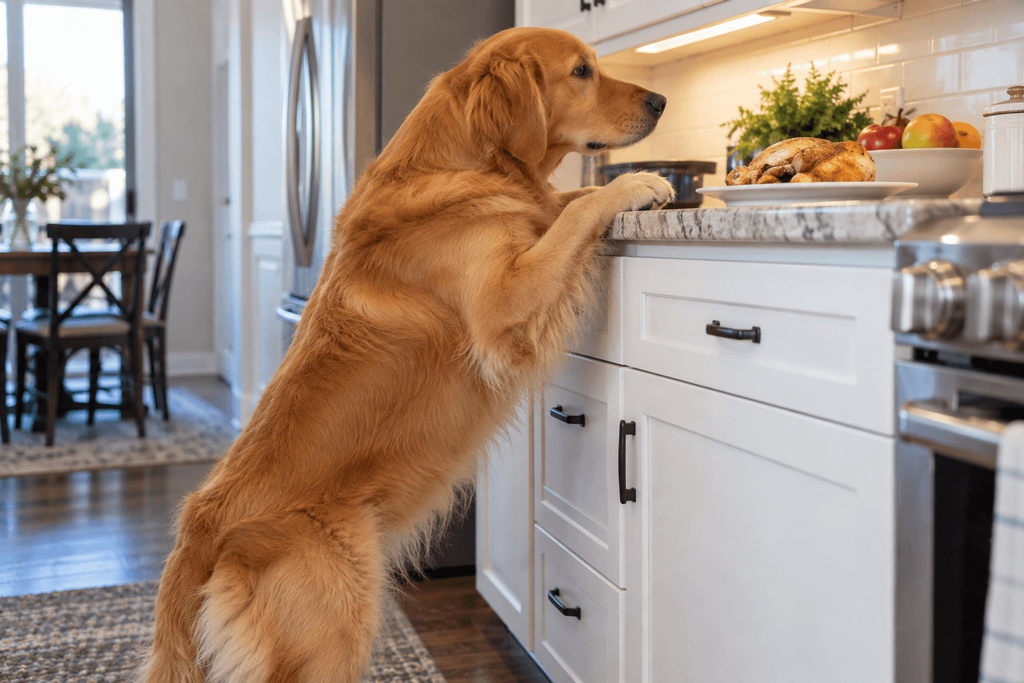
Counter surfing training teaches your dog to stop jumping onto kitchen counters, tables, and other elevated surfaces to steal food. If your dog has ever grabbed bread off the counter, snatched dinner from the table, or knocked over a trash can to find food, you’re dealing with a common and frustrating household behavior.
This guide covers practical training techniques, environmental management strategies, and alternative behaviors that can be adapted to puppies and adult dogs. Whether you’re dealing with a young dog that has recently discovered the counter or an adult dog with a long history of stealing food, the same core principles can help. The content is designed for Phoenix-area dog owners who want a practical approach that can be maintained at home.
Dog counter surfing training combines management with cues such as “leave it” and “place” and rewards appropriate alternatives to stealing food. Progress varies depending on how long the behavior has been practiced, how often the dog still gains access to food, and how consistently the household follows the training plan.
By the end of this guide, you will:
- Understand why dogs counter surf and what reinforces the habit
- Learn core training techniques for responding to food temptation
- Know how to set up your environment to support training
- Troubleshoot common setbacks such as stealing food when you’re away
- Maintain consistent household rules that support long-term training
Understanding Counter Surfing Behavior
Dog counter surfing is typically opportunistic food-seeking behavior. Dogs are natural scavengers, and accessible food can quickly make checking counters worthwhile. When a dog occasionally finds something rewarding on a counter or table, the behavior can become a repeated habit. Understanding that reinforcement pattern helps you choose an effective management and training approach.
Why Dogs Counter Surf
Counter surfing can become self-rewarding. Unlike a behavior that depends entirely on attention from a person, finding food on the counter provides an immediate reward. Every successful food theft gives the dog another reason to check the counter later.
A dog does not need to find food every time it checks the counter for the behavior to continue. Occasional success can reinforce repeated checking, especially when the reward is highly valuable food. Size, reach, and access also affect opportunity: some dogs can reach a counter directly, while others may use nearby furniture or other accessible surfaces.
Understanding this motivation shapes the training approach. Instead of relying only on telling the dog what not to do, reduce access to food and reinforce behaviors that are incompatible with counter surfing.
Common Triggers and Scenarios
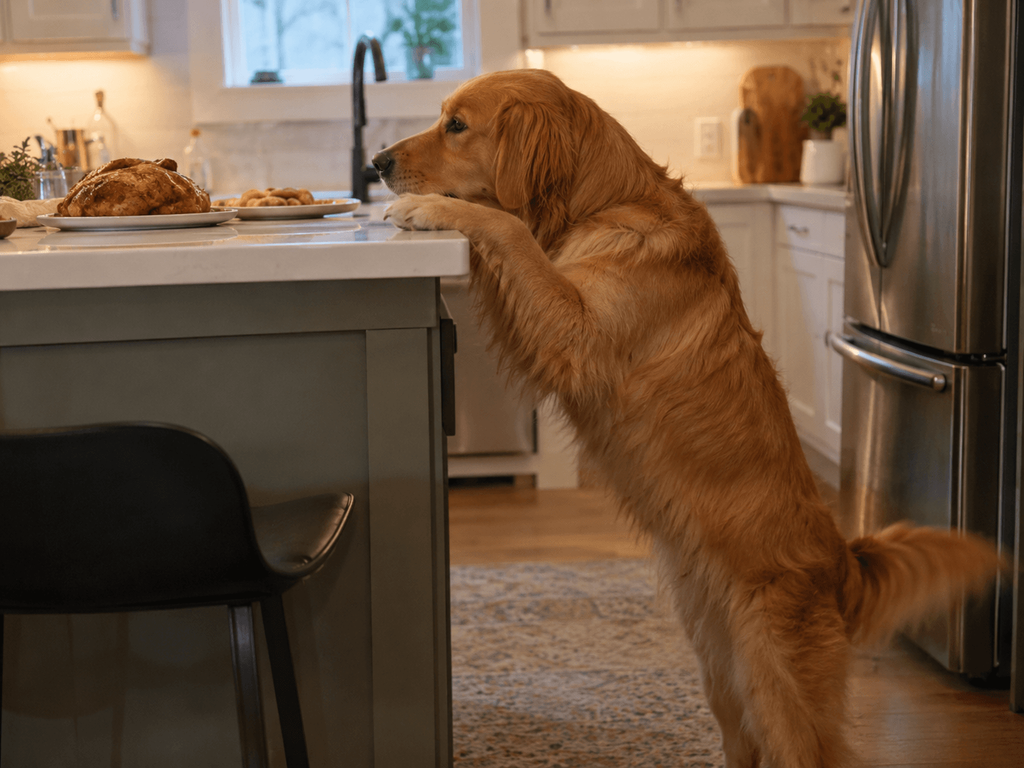
High-risk moments for counter surfing are fairly predictable: cooking when food is out, unattended meals on a table or coffee table, accessible trash, and gatherings where plates may be left within reach. Leaving food accessible increases the opportunity for the behavior to be rewarded.
Counter surfing often becomes easier when a dog has unsupervised access to the kitchen. Stepping into another room or leaving the house can create an opportunity if food remains accessible. Open floor plans can also make management more challenging because there may be no door to close. A dog’s size, reach, and access to nearby furniture can influence what surfaces it can reach.
Dogs may also investigate trash cans or other areas where food is available. Family gatherings and dinner parties can create additional challenges because there may be more food, more distractions, and less consistent supervision.
With this behavioral understanding in place, the next step is teaching specific alternatives while preventing repeated opportunities to steal food.
Fundamental Training Techniques
Now that you understand why your dog checks counters and why the behavior can become persistent, you can combine management with training appropriate alternative behaviors. Reward-based training gives your dog clear information about what to do instead of relying only on stopping the unwanted behavior.
The “Leave It” Command
Teaching the “leave it” cue helps a dog disengage from tempting food or another item. It can be a useful component of impulse control training and everyday household manners.
Start simple: hold a low-value treat in a closed fist. When your dog sniffs, paws, or mouths at your hand, wait. The moment your dog pulls back or looks away, mark the behavior with “Yes!” or another consistent marker and reward with a different treat from your other hand.
Practice until your dog understands that disengaging from the closed hand earns the reward.
Then progress by placing food on the floor and covering it with your hand, followed by practicing with uncovered food while using a leash for management. Gradually introduce more realistic distractions only when your dog is successful at the easier level. Keep sessions brief and reward promptly when your dog disengages from the food.
Place Command Training
Establishing a “place” cue can help keep a dog away from counters during cooking. A dog that remains on its bed, mat, or platform cannot simultaneously put its paws on the kitchen counter.
Begin teaching “place” in a quiet room with minimal distractions. Use a mat, bed, or raised platform. Guide your dog onto the surface, mark when all four feet are on it, and reward.
Build duration gradually. Once your dog can remain on place reliably in a calm environment, begin practicing closer to the kitchen before adding food-preparation distractions.
The combination of “leave it” and “place” can be useful because the cues serve different purposes. “Leave it” helps the dog disengage from a tempting item, while “place” provides a specific location and alternative behavior during high-risk periods.
Management and Environmental Setup
Management means reducing opportunities for your dog to find food while the new behavior is being trained. If the counter continues providing valuable rewards, the dog has a reason to keep checking it.
Key management strategies include:
- Keep counters clear of accessible food so checking the counter is less likely to pay off
- Use baby gates or closed doors when you cannot supervise kitchen access
- Secure trash and food storage so your dog cannot easily reach discarded or stored food
- Remove easy climbing access by pushing in chairs and moving stools when appropriate
- Use a crate, pen, or separate room when needed if your dog is already comfortable with that form of confinement
Baby gates and closed doors do not need to be permanent. They can be useful management tools while your dog develops more reliable habits.
Also reward appropriate behavior near the kitchen. If your dog stays on the floor, moves to place, or disengages from food when asked, mark and reinforce that choice.
These three components—impulse-control cues, place training, and environmental management—create a practical foundation for counter surfing training.
Advanced Training Implementation and Programs
Once the basic skills are established, gradually practice them in more realistic situations. The goal is not to rush through a predetermined timetable but to increase difficulty only when your dog is consistently successful at the current level.
Step-by-Step Training Protocol
Use this progression when counter surfing is already established or when you want to build greater reliability:
- Set up management: Clear accessible food from counters, secure trash, remove easy climbing access, and restrict kitchen access when you cannot supervise.
- Teach skills with low distractions: Practice “leave it,” “off,” and rewarding four paws on the floor in an easier environment first.
- Introduce the place cue: Build a reliable mat or bed behavior away from food before moving the exercise closer to the kitchen.
- Add kitchen distractions gradually: Practice while preparing food only after your dog can succeed with easier distractions.
- Use the skills during daily routines: Practice during cooking and meals while maintaining the same household rules.
- Generalize carefully: Increase distractions and duration gradually rather than deliberately leaving tempting food within easy reach to test the dog.
- Maintain the behavior: Continue management when necessary and return to easier training steps if counter surfing begins again.
Progress varies from dog to dog. A recently learned habit may respond differently from counter surfing that has been repeatedly rewarded for months or years. Instead of relying on a fixed deadline, track how often the behavior occurs and whether your dog is becoming more reliable with alternative behaviors while opportunities to steal food are reduced.
Training Method Comparison
| Criterion | Reward-Based Training + Management | Management Only | Aversive/Correction-Based Methods |
| Core approach | Reinforce alternative behaviors while preventing access to rewards | Prevent access to food and high-risk areas | Use unpleasant consequences intended to reduce behavior |
| What it addresses | Teaches the dog what to do while limiting opportunities to counter surf | Prevents rehearsal while management is in place | May suppress behavior without necessarily teaching an alternative |
| Limitation | Requires consistent practice and household management | Does not by itself teach a replacement behavior | Carries welfare and human-dog relationship concerns |
| Professional guidance | Consistent with current reward-based recommendations from veterinary behavior professionals | Useful as part of a broader training plan | Veterinary behavior organizations recommend avoiding aversive training methods |
Some owners ask about electronic collars or other correction-based tools for counter surfing. The American Veterinary Society of Animal Behavior recommends reward-based methods for dog training and advises against aversive methods, including electronic collars.
If you prefer a reward-based approach, marker training can help reinforce behaviors such as disengaging from food, staying on place, and keeping four paws on the floor.
Off Leash K9 Training Phoenix’s 2 Week Board & Train currently includes skills such as Place, Off, meal manners, and obedience around distractions. Counter surfing is not specifically listed as a guaranteed program outcome, so owners concerned about food stealing should discuss the behavior with the training team before choosing a program. The program also includes an owner handoff session focused on maintaining the trained skills at home.
Common Challenges and Solutions
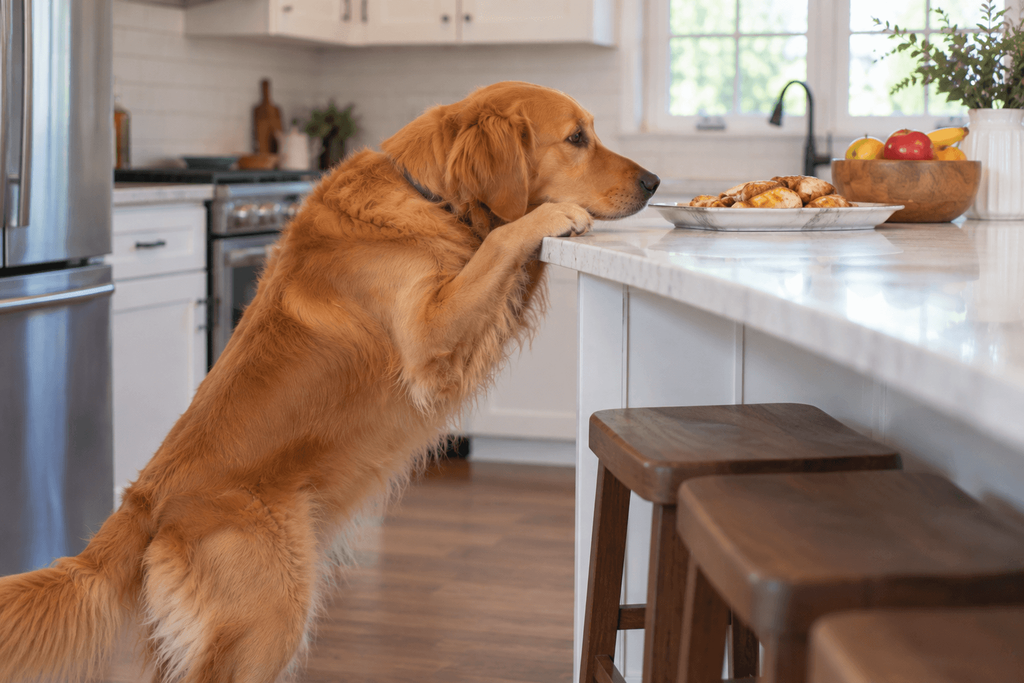
Even with solid training fundamentals, setbacks can occur. Identifying when and where the behavior happens can help you adjust your management and training plan.
Dog Only Steals When Owner Is Away
Counter surfing is difficult to address if the dog continues finding food during unsupervised periods. Use gates, closed doors, or another appropriate management setup when you cannot supervise, and keep accessible food off the counter.
A crate may be useful for a dog that is already comfortable resting there, but it should not be introduced as punishment for counter surfing.
A home camera can help you identify when and where the behavior occurs while your dog is alone. Long-term training should focus on reinforcing appropriate alternatives, but environmental management remains important whenever tempting food is accessible and you cannot supervise.
Multiple Dogs and Counter Surfing
In a multi-dog household, counter surfing can be harder to monitor because more than one dog may have access to food.
Practice “leave it” and “place” with each dog individually before expecting the same reliability in a group. If the dogs show competition around food, manage meals and high-value items separately as appropriate.
Inconsistent Family Members Undermining Training
Inconsistent household routines can make counter surfing harder to change. One person may leave food within reach while another consistently manages the kitchen, allowing the dog to continue finding occasional rewards.
Agree on simple household rules, such as:
- Do not leave unattended food within the dog’s reach
- Use the same cues consistently
- Reward appropriate behavior around food
- Use gates or another management strategy during busy gatherings when supervision will be difficult
Shared training sessions can also help family members understand how and when to use “leave it,” “place,” and other cues.
Dog Continues Despite Consistent Training
If counter surfing remains frequent despite consistent management, review whether the dog is still finding food on counters and whether the alternative behavior has been sufficiently reinforced.
If your dog has developed an unusual increase in appetite—especially with weight loss, increased thirst, increased urination, or other health changes—contact your veterinarian.
Also review your dog’s daily activity and enrichment. Food puzzles, appropriate chew activities, sniffing opportunities, and structured training can provide constructive outlets, although they do not replace counter management.
If the behavior persists, a qualified trainer can review your setup, timing, reinforcement, and household routine and help determine whether private lessons or another training format is appropriate.
Conclusion and Next Steps
Successful dog counter surfing training relies on reducing opportunities for food stealing, teaching clear alternative behaviors, and keeping household expectations consistent. An occasional successful food theft can reinforce the behavior again, so management remains useful even as your dog’s training improves.
Start with these steps:
- Audit your environment: Clear accessible food from counters, secure trash, remove easy climbing access, and manage kitchen access when you cannot supervise.
- Begin place training: Practice in a low-distraction area before introducing kitchen distractions.
- Teach “leave it”: Start with easier items and gradually progress toward realistic food situations.
- Get your household on the same page: Use shared rules and consistent cues.
- Track progress and adjust: If counter surfing is not becoming less frequent despite consistent management and training, review the plan or seek professional guidance.
If your dog’s counter surfing remains difficult to manage or you also want help with obedience and manners, Off Leash K9 Training Phoenix offers private obedience training, Board & Train options, and reward-based Basic Marker Mastery™. A free phone consultation can help you compare the currently available programs and discuss your training goals.
For related training topics, explore resources on marker training and other obedience skills that can support clearer communication and better behavior around distractions.
Frequently Asked Questions
Why does my dog only counter surf when I am not home?
Dogs may counter surf more when no one is supervising because accessible food can reward the behavior. Keep food out of reach and use gates, closed doors, or another appropriate management setup when needed. A crate can be useful if your dog is already comfortable resting there.
How long does it take to stop counter surfing behavior?
There is no standard timeline. Progress depends on how often the behavior has been rewarded, how effectively access to food is managed, and how consistently alternative behaviors are practiced. Track the frequency of counter surfing rather than expecting improvement by a fixed date.
Can I use punishment or shock collars to stop counter surfing?
The American Veterinary Society of Animal Behavior recommends reward-based training and advises against aversive methods, including electronic collars. Management plus reinforcement of behaviors such as “leave it,” “place,” and keeping four paws on the floor gives the dog an alternative behavior to practice.
What if I have multiple dogs that counter surf?
With multiple dogs, practice “leave it” and “place” individually before working with the dogs together. Manage kitchen access for every dog, and separate food or feeding areas if competition around food is a concern.
How can I prevent my dog from accessing the kitchen during meal prep?
Use baby gates, closed doors, or another appropriate barrier during cooking or eating when needed. Keep food away from counter edges and secure trash so the dog has fewer opportunities to practice counter surfing.
What should I do if my family members are inconsistent with training?
Agree on simple household rules about food storage, kitchen access, cues, and rewards. Everyone does not need identical training skills, but consistent expectations make it easier for the dog to understand which behaviors are rewarded and which areas or foods are off-limits.
