
Introduction
Puppy proofing your home is the single most important step you should take before bringing a new puppy through your front door. A curious puppy will chew, swallow, climb, and investigate every reachable surface, cord, and corner-and without preparation, the results range from destroyed shoes to life-threatening emergencies. Home puppy proofing combines hazard removal, physical barriers, and smart product choices to create a safe environment where your new furry family member can explore, learn, and grow without getting hurt.
This guide covers indoor and outdoor safety measures room by room, with specific attention to the extreme heat and desert hazards Phoenix-area dog owners face. Whether you live in a single-story home in Scottsdale or a multi-level house in Chandler, these puppy proofing tips apply to you. The target audience is new and soon-to-be puppy owners who want practical, evidence-based steps-not vague advice.
Direct answer: Puppy proofing involves removing potential hazards from every room, securing dangerous items behind locks and barriers, and creating designated safe spaces so your naturally curious pup is protected from harm while destructive behavior is prevented before it starts.
Here’s what you’ll gain from this guide:
- A safer, stress-free environment for your puppy from day one
- Significantly reduced risk of property damage and expensive vet bills
- Peace of mind knowing your home is systematically secured against the most common puppy dangers
- A solid foundation for successful obedience training and good behavior habits
Understanding Puppy Behavior and Safety Needs
Before you start installing baby gates and hiding cleaning supplies, it helps to understand why puppies get into so much trouble. Their behavior isn’t random mischief-it’s driven by biological instincts and developmental stages that make virtually everything in your house fair game.
Teething and Chewing Behaviors
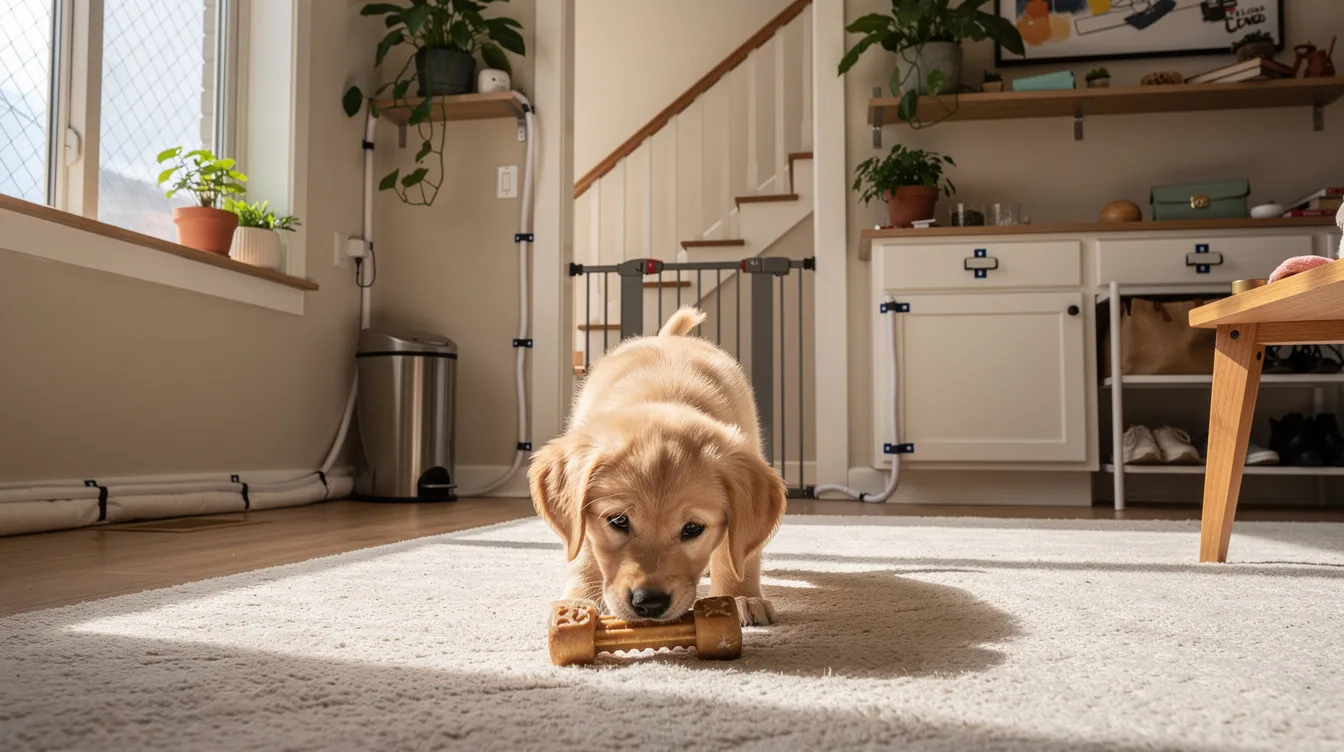
Between approximately 3 and 6 months of age, puppies enter the teething period when their baby teeth fall out and are replaced by adult teeth. During this stage, chewing is constant because it relieves oral discomfort, promotes proper jaw development, and strengthens emerging teeth. This is why your pup will gnaw on furniture legs, electrical cords, remote controls, and anything else within paw’s reach. Redirecting chewing behavior is essential for puppy training-rather than fighting the instinct, you channel it toward appropriate chew toys. Provide appropriate chew toys (rubber, frozen teething rings, textured options) so your puppy has satisfying alternatives to your belongings.
Understanding this timeline matters for safety planning: a puppy that barely reaches the couch at 8 weeks will be climbing on low tables and countertops by 4 months. What’s puppy safe today may not be tomorrow.
Curiosity and Ingestion Risks
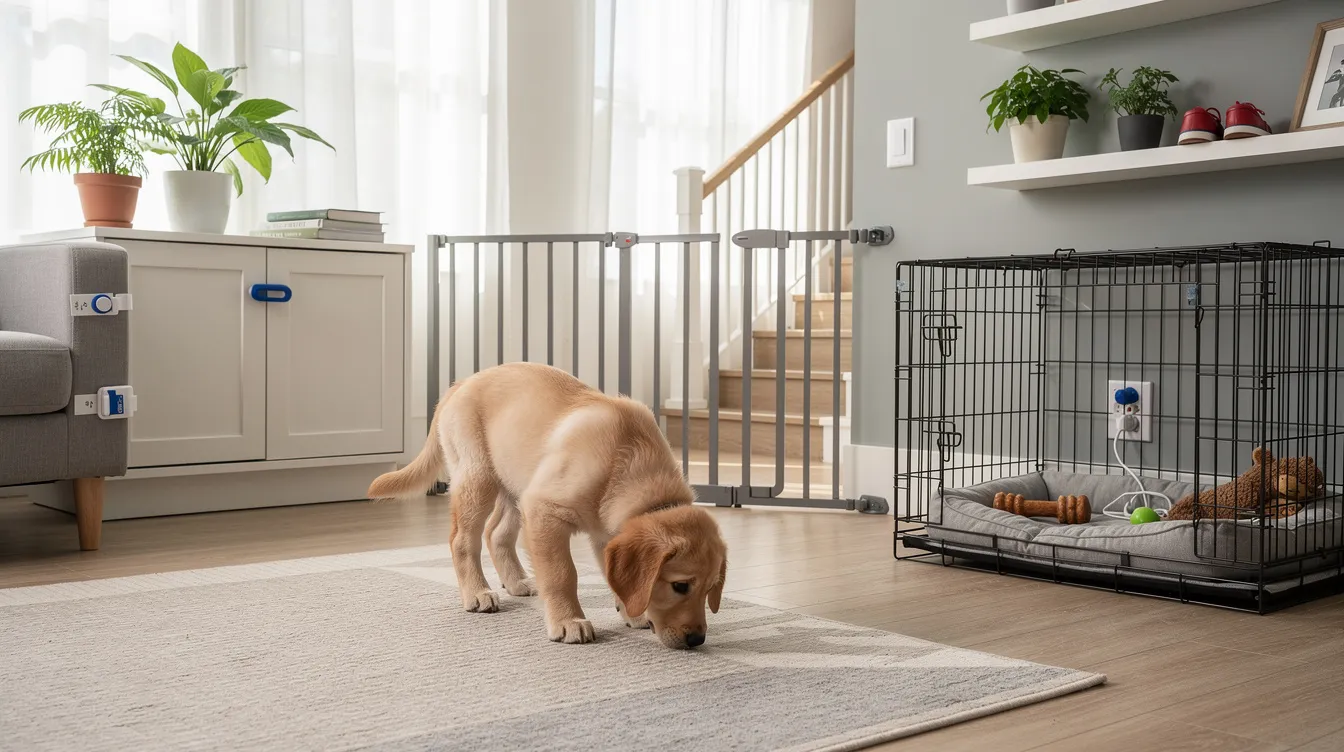
Puppies explore the world with their mouths. Everything they encounter-small objects, rubber bands, hair ties, coins, batteries-gets tasted, chewed, and sometimes swallowed. This oral exploration can lead to choking, intestinal blockages, or poisoning. The ASPCA Animal Poison Control Center reported roughly 199,000 poisoning cases in dogs in a single year, with about 20% arising from ingestion of human food alone. Common culprits include chocolate, grapes, xylitol (found in sugar-free gum and other sugar-free products), onions, and medications left on nightstands.
Puppy socialization is crucial between 7 and 16 weeks old, which means your pup needs to explore-but that exploration must happen in controlled, safe conditions. This behavioral understanding connects directly to the practical, room-by-room approach we’ll cover next.
Essential Puppy Proofing Areas
With a clear picture of how curious pups think and what drives their chewing hazards, let’s walk through the specific danger zones in your home. Each room presents its own set of challenges, and a systematic approach ensures nothing gets overlooked.
Kitchen and Dining Areas
The kitchen is arguably the most dangerous room for a new pup. Toxic foods are stored at ground level in pantries, trash cans overflow with bones and food scraps, and cabinets under the sink hold concentrated cleaning chemicals. Chocolate, grapes, onions, garlic, alcohol, and xylitol are all substances poisonous to dogs commonly found in kitchens.
Secure trash cans with locking lids to prevent access-a simple spring-loaded lid won’t stop a determined puppy. Install childproof latches on lower cabinets, especially those holding cleaning supplies, sharp utensils, or household chemicals. The AKC recommends moving all cleaners to high shelves and locking cabinet doors as baseline precautions. Pull-out drawers present pinch risks and easy access to dangerous items, so drawer locks are equally important.
Living Areas and Bedrooms
Your living room and bedrooms contain a surprising density of hazards. Electrical cords from lamps, chargers, and entertainment systems are attractive chew targets that can cause electrical shock, burns, or electrocution. Keep electrical cords covered with cord protectors or routed behind furniture to prevent chewing hazards. Small items left on the floor-coins, jewelry, buttons, Lego pieces if you have children-are choking hazards that puppies will find and eat.
Medications and vitamins stored on nightstands or in low drawers are extremely dangerous. Store medications and chemicals out of puppy’s reach-ideally in closed containers on high shelves. Certain houseplants like Sago Palm are toxic to dogs, as are Philodendron, Jade Plant, and Aloe Vera. Remove toxic plants to ensure puppy safety, or relocate them to rooms your puppy cannot access. Shoes, remote controls, and chewable objects on low tables are all fair game for a teething puppy and should be stored out of reach.
Bathrooms and Laundry Rooms
Keep bathroom doors closed at all times, or install latches your puppy can’t defeat. Toilets pose a genuine drowning risk for small puppies, so keep toilet lids down and consider toilet lid locks. Bathroom cabinets typically hold bleach, toilet bowl cleaners, medications, perfumes, and laundry detergent pods-all of which are toxic or harmful if ingested. Household chemicals should be stored out of puppy reach, ideally behind locked cabinet doors.
Small objects like hair ties, rubber bands, cotton swabs, and razor cartridges are common in bathrooms and can cause intestinal blockages if swallowed. Laundry rooms add dryer sheets and detergent pods to the risk list. A curious puppy doesn’t care whether something will taste good-it only cares that it fits in its mouth.
With indoor areas covered, the next step is building a systematic process for implementation.
Step-by-Step Puppy Proofing Process
Knowing which rooms are dangerous is only useful if you act on that knowledge methodically. The following process turns room-by-room awareness into a complete, tested puppy home safety system.
Room-by-Room Safety Checklist
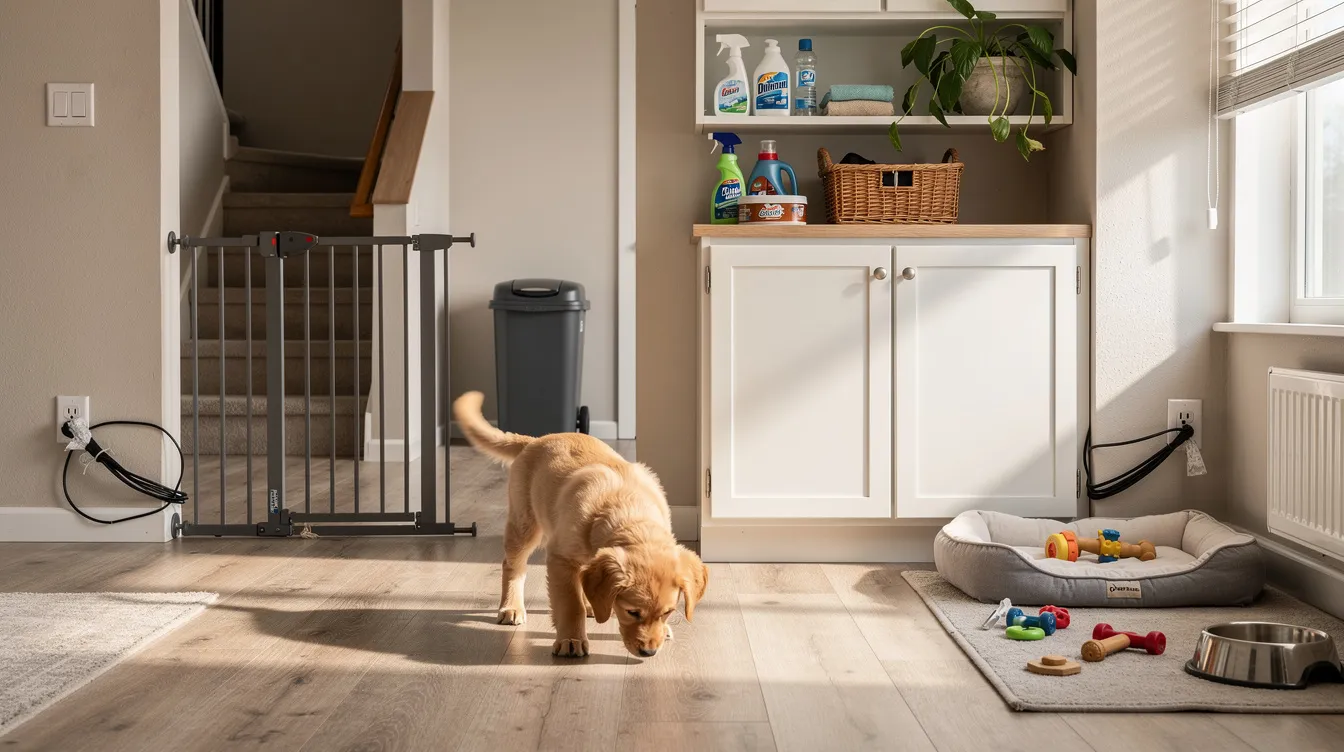
Complete this process before your new puppy arrives. Puppy-proofing requires inspecting your home from a puppy’s eye level-literally get on your hands and knees and crawl through each room. Create a puppy-proofing checklist that includes inspecting every area a puppy will access.
- Walk through each room at puppy eye level. Crawl on the floor and identify every reachable cord, small object, toxic plant, and accessible cabinet. Regularly check and remove sharp objects that could injure a puppy.
- Remove or secure all hazardous items. Relocate toxic foods, medications, chemicals, and small items to high, locked storage. Move toxic plants entirely out of the home or to inaccessible rooms.
- Install baby gates and barriers. Use baby gates to confine puppies to safe zones-hardware-mounted gates are required at stair tops and near hazardous areas. Puppy playpens are useful when supervision isn’t possible.
- Test all safety measures. Apply force to every gate, lock, and cover to simulate puppy strength. Tug cabinet locks, push against gates, and verify outlet covers are flush. If adhesive locks pull free, switch to screw-mounted alternatives.
- Create designated safe zones. Establish a designated safe zone with a crate and puppy-safe toys. Crate training can help manage a puppy’s chewing habits and provides a secure space when you can’t supervise directly. Designated areas help manage a puppy’s environment and reduce anxiety.
Essential Safety Products Comparison
Choosing the right products matters. Gates certified to ASTM child safety standards (ASTM F1004-23) offer tested resistance to force, proper slat spacing, and reliable latches-important even for pet use. Here’s how common safety products compare:
| Product Type | Best Use | Price Range | Key Consideration |
|---|---|---|---|
| Hardware-mounted baby gates | Stair tops, hazardous rooms | $100–$200 | Withstands 100+ lbs of force; most secure option |
| Pressure-mounted gates | Room doorways, temporary barriers | $25–$50 | Requires frequent tightening; not for stairs |
| Magnetic cabinet locks | Kitchen/bathroom cabinets | $25–$35 (12-pack) | Hidden, tamper-resistant; needs magnetic key |
| Adhesive strap locks | Drawers, lower cabinets | $10–$20 (kit) | Visible; may fail with moisture or Phoenix heat |
| Cord protectors | Living rooms, offices, bedrooms | $8–$15 per set | Essential for preventing electrical shock |
| Locking-lid trash cans | Kitchen, bathrooms | $30–$60 | Foot pedal + locking lid; secure lids critical |
For Phoenix homes specifically, adhesive-based products may degrade faster in high heat; screw-mounted magnetic locks offer more durability in our climate. When choosing gates, account for your puppy’s expected adult size and energy level; a Labrador puppy will outgrow a 24-inch gate quickly.
These products create the physical framework, but real-world implementation always surfaces challenges.
Common Puppy Proofing Challenges and Solutions
Even the most thorough puppy proofing plan hits obstacles. Here are the issues Phoenix-area dog owners encounter most frequently and how to solve them.
Persistent Chewing Despite Proofing
Physical barriers can’t stop every chewing impulse. When your puppy chews something inappropriate despite your efforts, the answer lies in providing lots of appropriate chew toys and rotating them regularly to maintain interest. Redirect every instance of unwanted chewing to an approved toy, then reward the switch with praise. Positive reinforcement methods build trust and encourage desirable behaviors-this is where puppy proofing and training work together. Teaching reliable “leave it” and “drop it” commands gives you a behavioral safety net that complements your physical one. Establishing a routine helps reduce anxiety in puppies, and consistent routines include feeding, potty breaks, and playtime-all of which reduce stress-driven destructive behavior.
Multi-Level Homes and Stair Safety
Stairs present a serious fall risk for young puppies whose coordination is still developing. Use hardware-mounted gates at both the top and bottom of every staircase-pressure-mounted gates can pop loose under force and must never be used at stair tops. For staircases without standard door frames, banister-to-wall gate systems or custom mounting kits provide secure alternatives. Supervise your puppy’s first stair experiences, and train them to stop and sit at stairs rather than barreling up or down unsupervised. As your puppy grows and their mobility changes, reassess your gate placement and barrier strategy every few months.
Outdoor Desert Hazards Specific to Arizona
Phoenix presents unique outdoor dangers that puppy owners in other climates simply don’t face. When ambient temperatures reach 100–110°F, asphalt surface temperatures often exceed 130–160°F-enough to burn paw pads in seconds. Walk your pup only during early mornings or evenings when pavement is cooler, and always test the ground with the back of your hand for five seconds before allowing your dog on it. Puppies are especially poor at regulating heat, making heat stroke a serious and fast-moving risk. Signs include body temperature above 104°F, excessive panting, drooling, and collapse.
Your yard requires its own proofing pass. Common poisonous plants in Phoenix landscaping include Oleander, Sago Palm, Desert Rose, Castor Bean, Lantana, and Euphorbia (Pencil Cactus)-even a small chew can cause drooling, vomiting, or organ damage. Remove these plants or fence them off completely. Check for cacti thorns at puppy level, ensure your yard fence is secure with no gaps, and be aware of scorpions and snakes that shelter in rock features or woodpiles. Never leave your puppy unsupervised in a garage, car, or unshaded yard-even for a few minutes.
Also note that chemical treatments like fertilizers and pesticides applied to yards or potted plants can be toxic even when the plants themselves are safe. If you’re dealing with a puppy reluctant to go outside in the heat, strategies for potty training in challenging conditions become especially relevant.
Conclusion and Next Steps
Puppy proofing your home isn’t a one-time task-it’s an ongoing process that evolves as your furry family member grows stronger, taller, and more resourceful. Proper home puppy proofing prevents emergencies, protects your belongings, reduces costly vet visits, and creates the stable foundation your puppy needs for successful training and a well-adjusted life.
Here are your immediate next steps:
- This week: Complete your room-by-room safety walk-through at puppy eye level, using the checklist approach above to identify and eliminate every potential hazard.
- Before puppy arrives: Purchase and install essential safety products-prioritize hardware-mounted gates, cabinet locks, cord protectors, and locking-lid trash cans.
- Within the first week home: Schedule a puppy training consultation with Off Leash K9 Training Phoenix for professional behavioral guidance that complements your physical safety measures. Establishing routines reduces puppy anxiety and helps acclimation from the very first day.
Related topics worth exploring include building foundational obedience commands (“leave it,” “come,” “stay”), establishing household routines, and learning about safe outdoor activities in Phoenix once your puppy is fully vaccinated and comfortable in the heat.
Additional Resources
- Puppy proofing checklist for Phoenix homes: Walk every room at floor level, check all cabinets and drawers, verify outdoor plants against the Arizona Poison & Drug Information Center’s plant database, test pavement temperature daily during summer, and inspect fence lines for gaps.
- Off Leash K9 Training Phoenix: For comprehensive puppy training support-including obedience, behavioral modification, and board-and-train programs-contact the team for a free consultation to protect your puppy’s well being and set them up for life-long good behavior.
- Emergency veterinary contacts: Save your nearest Phoenix-area emergency vet clinic number in your phone before your puppy arrives. For suspected poisoning, contact the ASPCA Animal Poison Control Center at (888) 426-4435.
