
Introduction
Teaching your dog to stay is one of the most important obedience skills you can build – and for Phoenix dog owners, it’s also one of the most practical. A reliable stay command prevents door dashing when delivery drivers arrive, keeps your dog safe near busy roads, and lays the groundwork for off-leash control in parks, trails, and your own backyard. Whether you’re working with a young puppy or an adult dog with ingrained habits, stay training follows a clear, systematic process that any owner can learn.
This guide covers everything from foundational concepts through advanced distraction-proofing, tailored specifically for dogs and owners living in the Phoenix metro area. You’ll find step-by-step instructions suitable for all breeds, ages, and temperaments – including adaptations for Arizona’s extreme heat and unique outdoor distractions. The focus is on positive reinforcement methods used in professional training programs, not punishment-based shortcuts that erode trust.
In short: stay training involves teaching your dog to remain in position until you give a release cue, built through a systematic approach of increasing duration first, then distance, and finally distraction tolerance. Teaching a dog to stay requires mastering the three Ds: Duration, Distance, and Distraction.
By the end of this guide, you’ll understand how to:
- Build a rock-solid stay that holds up across time, space, and environmental chaos
- Improve your dog’s safety in doorways, near traffic, and off-leash settings
- Strengthen the foundation for recall, place commands, and other obedience cues
- Create distraction-proof behavior that works indoors and outdoors in Phoenix conditions
- Sharpen communication between you and your dog through consistent verbal cues, hand signals, and release words
Understanding the Stay Command
At its core, the stay command means hold position until released. It’s not a suggestion or a momentary pause – it’s a deliberate exercise in impulse control where your dog remains in a specific position (sit, down, or stand) until you return and formally free them. For many dog owners in Phoenix dealing with outdoor distractions like wildlife, heavy foot traffic, and off-leash dogs at parks, this level of control isn’t optional – it’s essential.
Research published in 2025 by Singer et al. found that training dogs to hold a stay under distractions improves their behavior in that specific context, though impulse control may not automatically generalize to unrelated tasks. This means you need to practice stay in the actual environments where you need it – not just your living room.
Stay vs Wait vs Other Commands
“Stay” and “wait” sound similar, but they communicate different expectations to your dog. Stay means the dog holds position rigidly until the handler physically returns and gives a release command. Wait is a softer, temporary hold – often used before crossing a threshold or pausing at a door, with the expectation that another cue follows shortly.
Cornell University’s veterinary program recommends using separate verbal cues for each command to avoid confusion. For example, you might use “stay” when you need your dog to remain on a place board while guests enter, and “wait” before crossing a street on a walk.
The release word ties everything together. A release cue tells your dog they’re free to move. Common release words include “okay,” “break,” and “free.” Without a consistent release word, your dog has no clear sign that the stay is over, which leads to premature position breaks and confusion. The AKC recommends using an excited tone when saying the release word to clearly mark the transition. This distinction becomes critical when you progress toward off-leash obedience training where verbal precision is everything.
The Three D’s of Stay Training
Every professional trainer builds stay around three layered dimensions – the three D’s:
- Duration: How long your dog holds the position. You start with just a few seconds and gradually extend to minutes. Start with duration before adding distance and distraction.
- Distance: How far you can move away from your dog while they maintain the stay. You add distance only after duration is solid.
- Distraction: Environmental stimuli your dog must ignore – from household sounds to other dogs, children, and Phoenix wildlife like lizards and roadrunners.
These build cumulatively. When you increase one D, you dial back the others. For example, when you start adding distance, shorten the duration. When you introduce different distractions, reduce both distance and duration. This principle – adjusting difficulty across dimensions – is what separates effective stay training from frustrating repetition.
Understanding these fundamentals sets the stage for practical implementation, starting with how to set up your training environment and choose the right starting position.
Basic Stay Training Fundamentals
With the three D’s framework in mind, the next step is preparing your dog, your environment, and your equipment before you begin the actual training process.
Choosing the Right Starting Position
Most dogs learn stay more reliably from a down position than a sit position. Down is physically more stable – a dog lying flat is less likely to break position than a dog that sits upright and can easily pop up or drift forward. PetMD recommends using down once your dog understands the basic stay concept.
That said, you need to teach your dog to sit before introducing stay. A dog that doesn’t respond reliably to the sit command or down cue on a verbal cue alone isn’t ready for stay training. Reward your dog after they hold a sit for a few seconds to build the association between stillness and positive outcomes.
For puppies, high-energy breeds, or dogs with joint issues common in larger Phoenix-area breeds (German Shepherds, Labrador mixes), adjust accordingly. A pup with developing joints may do better in a sit position for shorter stays, while a senior dog might find a prolonged down uncomfortable on hard tile.
Setting Up Your Training Environment
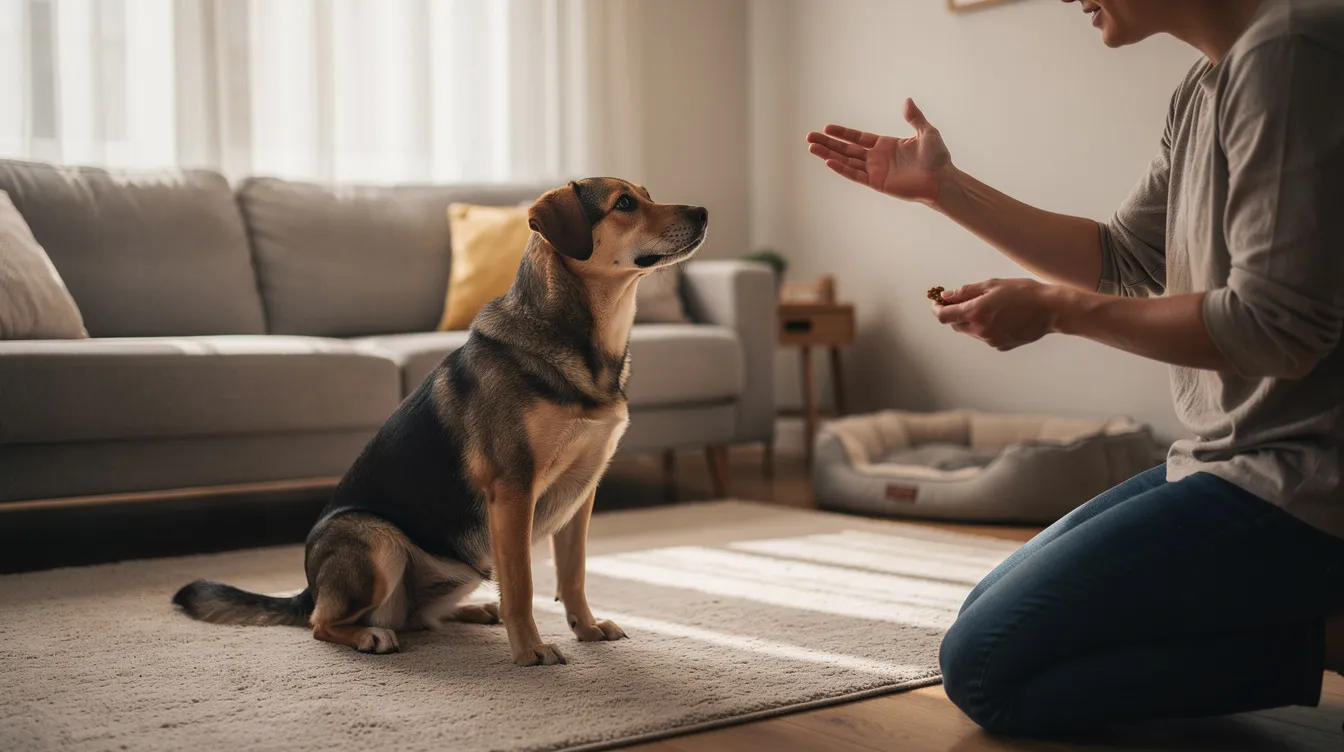
Begin training in a quiet space without distractions. Your living room or a hallway works well – somewhere your dog already feels comfortable. Start training in a quiet space with minimal distractions to establish commands before adding complexity.
Phoenix homes present some unique considerations. Tile and linoleum floors can be slippery, making a down stay uncomfortable or unstable. A training mat or rug gives your dog a defined, comfortable surface. Air conditioning units, ceiling fans, and ambient noise from outside count as low-level distractions – pick the quietest room in the house initially.
When you’re ready to move outdoors, training on neutral ground is powerful for generalization. But in Arizona, timing matters: train early morning or after sunset to avoid heat stress and burned paws on concrete. Shaded patios or covered parks are ideal transitional spaces.
Essential Equipment and Rewards
Keep your setup simple:
- Training mat or place board: Gives your dog a clear physical boundary, which makes the position requirement obvious
- High-value treats: Cheese, chicken, freeze-dried liver. In Phoenix weather, choose non-melting options – freeze-dried treats hold up better than soft treats in 110°F heat
- Marker signal: A clicker or consistent marker word like “yes!” improves your timing of reinforcement dramatically
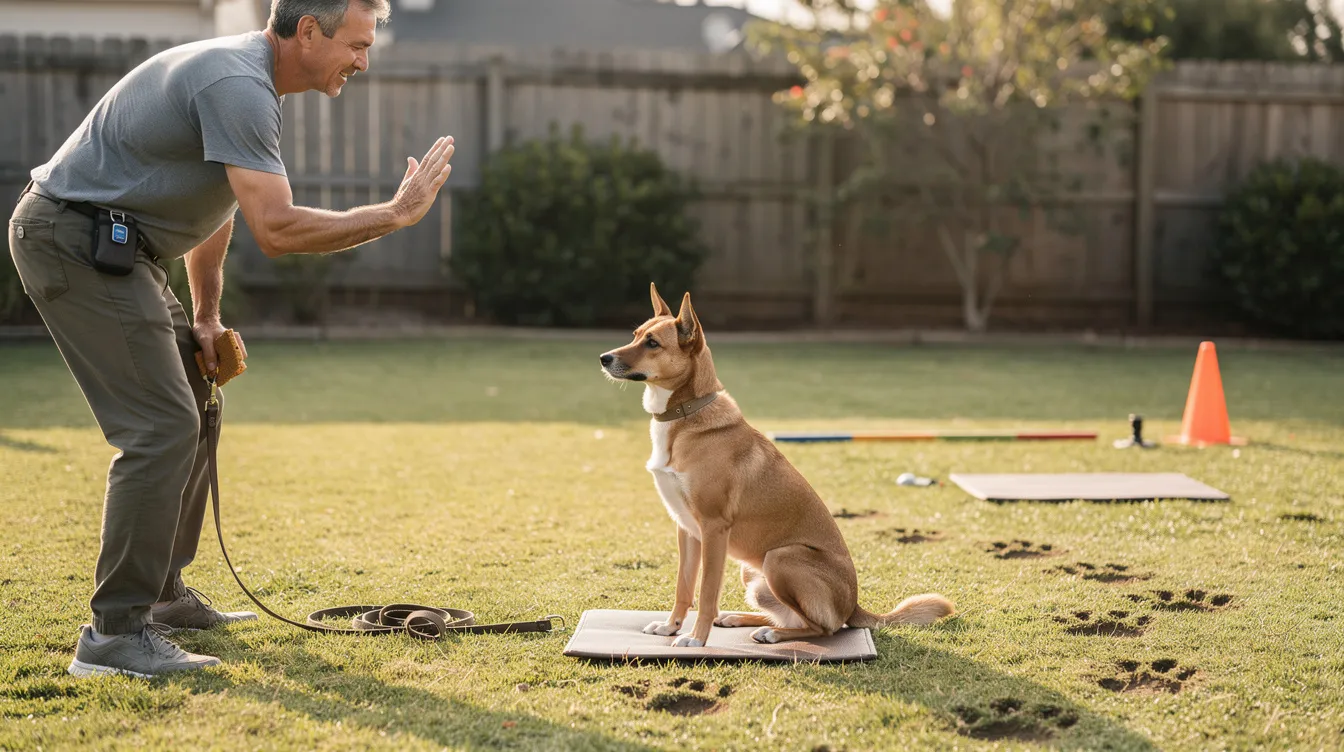
- Long leash: A 15-20 foot line provides safety when you practice stay outdoors and begin increasing distance
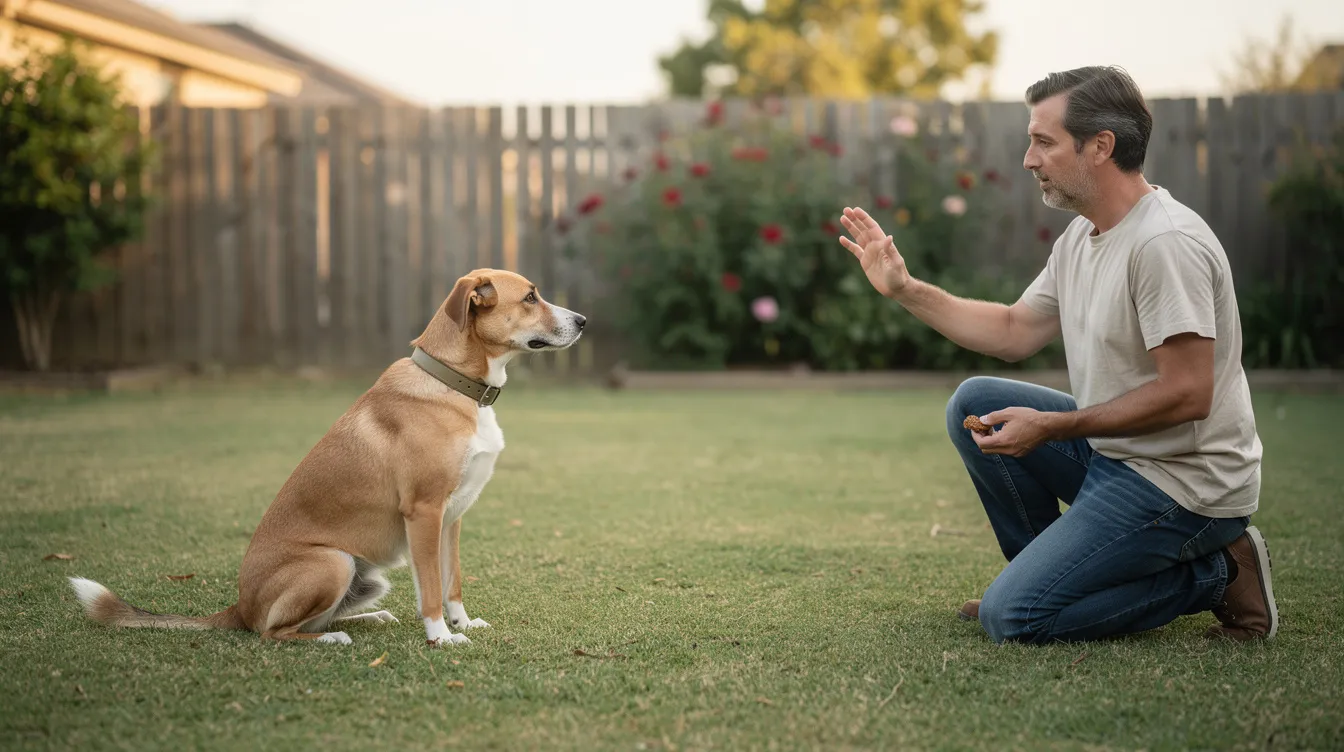
- Hand signal: A flat palm facing the dog, held briefly, accompanies the verbal stay cue. Dogs can learn cues without voice commands, making training easier in noisy environments – useful during Phoenix monsoon season or near busy streets
Step-by-Step Stay Training Process
Now that your fundamentals are set, here’s the systematic approach to building a reliable stay. This mirrors the progression used in basic and advanced obedience programs – starting simple, layering difficulty only when the dog demonstrates consistent success.
Phase 1: Building Duration
Focus solely on duration first. No distance, no distractions – just building your dog’s ability to remain still for increasing amounts of time. Training sessions should be kept short to prevent frustration or overwhelm in dogs.
- Ask your dog to sit or lie in a down position
- Say your stay cue clearly, paired with your hand signal (flat palm)
- Wait 1-2 seconds – start training stay with short durations of 1-2 seconds
- Mark the behavior (“yes!” or click) while your dog is still in position
- Return to your dog and deliver the treat – reward the stay, not the release, to reinforce behavior
- Give your release command (“break” or “free”) in an excited tone
- Repeat, increasing stay duration by 1 second at a time
Aim for a 10-second stay before increasing difficulty. Then gradually increase toward 15 seconds. Introduce the stay command formally after 15 seconds of sitting reliably. Preventive Vet suggests building to 45-60 seconds of duration alone before heavily focusing on distance.
Vary your intervals – sometimes ask for 5 seconds, sometimes 12, sometimes 8. This unpredictability keeps your dog engaged and prevents them from anticipating the release. If your dog breaks position at any point, don’t punish. Simply reset and return to the last successful duration. Build slowly. Gradually increase the delay before rewarding your dog, adding a few more seconds each session.
Phase 2: Adding Distance
Once your dog can hold a good stay for 30-60 seconds reliably indoors, you’re ready to add distance. Add distance to the stay command after the dog can hold the position reliably.
- With your dog in position, give the stay cue and take one step backward
- Immediately return and reward – don’t release from a distance yet
- Practice until one step is effortless, then add a second step
- Gradually extend to moving across the room, always returning before you release
- Practice in different rooms of the house to begin generalization
- Build to 20+ feet of distance, eventually stepping around corners and briefly out of sight
Always return to your dog before releasing them. This is critical – if you release from a distance, you’re teaching your dog to move toward you on the release, which can degrade the stay over time.
Use a long leash when you start adding distance outdoors. If your dog breaks, calmly guide them back to position without scolding. Consistency is crucial in dog training to help dogs understand expectations.
Phase 3: Introducing Distractions
After achieving reliable duration and some distance, begin layering in distractions. Introduce distractions only after achieving 30-second stays. Start with duration before adding distractions, and introduce distractions slowly for effective obedience training. Use small distractions like clapping before larger ones.
| Distraction Level | Indoor Examples | Outdoor Examples |
|---|---|---|
| Low | Handler clapping, mild movement around room | Light foot traffic, distant dogs |
| Medium | Toys thrown nearby, food placed on floor | Other dogs playing, children running |
| High | Doorbell ringing, visitors entering through door | Loose dogs approaching, wildlife in sight |
When you increase the distraction level, dial back duration and distance. For example, if your dog can hold a 60-second stay at 15 feet in a quiet house, drop to a 10-second stay at 3 feet when you first introduce a new distraction. This sets your dog up to win.
Practice stay in various environments to build reliability. Context matters – research confirms that impulse control learned in one environment doesn’t automatically transfer to others. A dog that holds a perfect stay in your living room may completely fall apart at a busy Phoenix dog park. You need to repeat the above steps in multiple locations.
For dogs with severe distraction issues – reactivity to other dogs, extreme prey drive toward desert wildlife, or fear-based behavior – a structured 2-week board and train program can accelerate progress through professional, controlled exposure that’s difficult to replicate on your own.
Common Challenges and Solutions
Even with a systematic approach, most dogs hit predictable roadblocks. Here’s how to address the most common issues seen in Phoenix-area training.
Dog Breaks Stay Early
When your dog breaks position repeatedly, it’s almost always a sign that criteria were advanced too fast. The solution is straightforward: reduce difficulty and return to the last successful level. If your dog was holding 20 seconds and now keeps breaking at 25, go back to 15 seconds and rebuild.
Don’t punish breaks. Positive reinforcement helps dogs learn desired behaviors during training, while punishment creates anxiety and avoidance. Simply reset your dog to position and try again at a lower difficulty. Keep sessions short – 5-10 minutes maximum – and end on a success. Watch your dog’s body language for signs of restlessness, lip licking, or leaning, which signal they’re reaching their threshold.
Won’t Stay When You Move Away
Some dogs follow their owner the moment they shift weight. This is common in puppies and dogs with separation anxiety. The solution: practice “fake outs.” Lean your body slightly away without stepping. When your dog sits and remains still, mark and reward. Then lean a bit further. Then shift one foot without completing a step.
Build distance in tiny increments – 6-inch movements rather than full steps. Your body language communicates more than your verbal cue in these early stages. Avoid dramatic turns or sudden movements that trigger your dog’s instinct to follow.
If trouble persists after weeks of practice, this may indicate an underlying anxiety issue worth exploring through professional behavior consultation.
Struggles with Distractions
When distractions overwhelm your dog’s stay, increase your reward value while decreasing every other difficulty element. Use the highest-value treat you have – real chicken, cheese, liver – and work at minimal distance with short duration in the presence of mild distractions.
Start small and build from there. A dog that can’t hold a stay when someone claps isn’t ready for a dog park. Gradually extend the distraction intensity over multiple sessions. For Phoenix owners, schedule outdoor distraction training during cooler hours when there’s naturally less foot traffic and your dog isn’t battling heat stress on top of environmental stimulation.
For dogs that are reactive, fearful, or aggressive in the presence of distractions, standard stay training may not be sufficient. These cases often require structured behavior modification programs that address the root emotional response, not just the obedience command.
Conclusion and Next Steps
Teaching your dog to stay is a process that rewards patience and systematic progression. You start small – a few seconds of stillness in a quiet room – and build toward a rock-solid stay that holds across duration, distance, and real-world distractions. The key is never advancing faster than your dog can succeed, and understanding that generalization requires practicing in multiple environments.
Here’s how to begin:
- Start with 10-15 minute daily sessions focused solely on duration in a quiet room
- Use your marker and high-value treats to reinforce stillness, not the release
- Don’t add distance until your dog holds a reliable 30-60 second stay
- Practice stay in various environments to reduce distractions and build real-world reliability
- For accelerated results or complex behavior issues, schedule a free phone consultation to discuss professional training options
Stay training connects directly to broader obedience goals – reliable recall, place commands, and the kind of off-leash control that makes life with your dog both safer and more fun. For Phoenix owners considering comprehensive training, understanding the differences between private lessons and board-and-train programs can help you choose the right path.
Additional Resources
- Off Leash K9 Training Phoenix’s 2-week board and train program provides accelerated stay training alongside full obedience work, ideal for owners who need faster results or have dogs with significant distraction challenges
- For puppies just beginning their training journey, starting at the right age makes a significant difference in long-term obedience outcomes
- Phoenix area owners can explore all training options and pricing at phoenixk9trainers.com
