
Off-leash obedience training is a goal many Phoenix dog owners share, but it should never start by simply unclipping the leash. Reliable listening takes dog obedience, structure, safety, and a step-by-step plan that teaches your dog to respond to real distractions.
If you are researching off-leash obedience training in Phoenix, AZ, this guide explains what to teach first, how to practice safely, and when professional help can make training clearer for both you and your dog.
Key Takeaways
- Off-leash obedience training in Phoenix, AZ must start with solid on-leash dog obedience and safety.
- Dogs need basic obedience first: come, sit and extended sit, down and extended down, place and extended place, loose leash heel, off, and especially strong recall before real off-leash freedom.
- Start with a leash or a 20 to 30 ft long line in secure, quiet areas, then slowly add distractions while following Phoenix leash laws in parks, neighborhoods, and desert trail areas.
- Structure, consistency, and gradual exposure matter more than speed. Rushing off-leash too soon creates risk.
- Professional dog trainers in Phoenix can help if recall, focus, leash pulling, or behavior around distractions are a struggle.
What is Off-Leash Obedience Training?
Off-leash obedience training means a dog reliably responds to commands without relying on leash pressure, even around distractions like other dogs, kids, bikes, desert wildlife, and busy sidewalks. It does not mean letting dogs run wherever they want. It means building reliable listening, quick recall, and calm behavior while still following leash laws and safety rules.
In Phoenix, this matters because the environment adds extra challenges. A dog may see rabbits near a wash, hear traffic along a canal path, or meet other dogs at a park. An off-leash dog must prioritize the handler over distractions like rabbits or other dogs.
The main goals are:
- Safety: prevent bolting into traffic, cactus-filled washes, canal edges, or hot pavement.
- Control: come when called, hold commands until released, walk in heel, and settle on command.
- Freedom: enjoy more relaxed hikes, patio outings, and neighborhood walks with better control, safer handling, and stronger listening when distractions appear. Off-leash practice should only happen in secure, legal off-leash areas or enclosed private spaces.
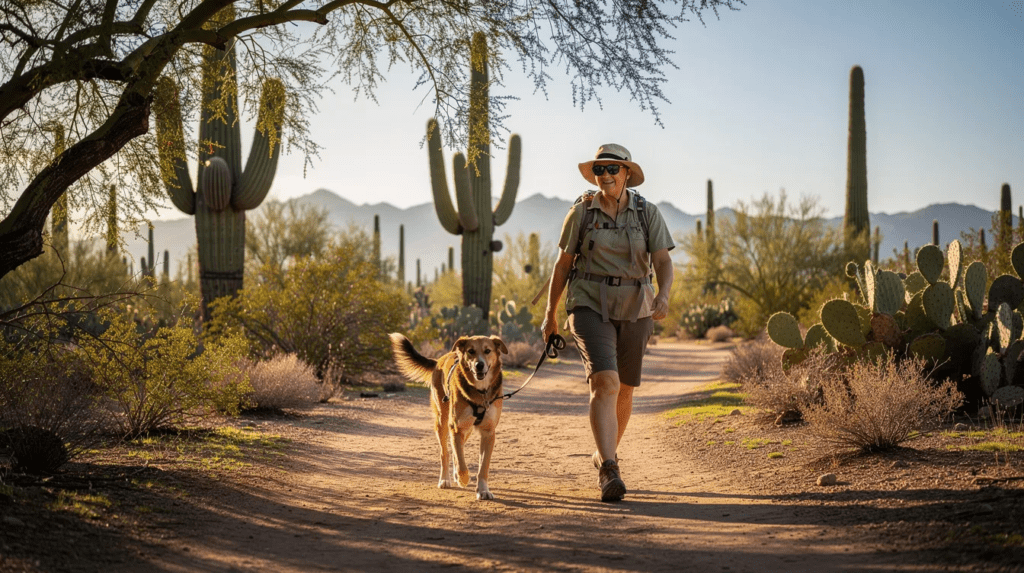
Many dog owners want off-leash obedience training Phoenix, AZ, because they want a well-trained dog that can stay focused in real-life places like South Mountain, Papago Park, neighborhood greenbelts, and busy walking areas. These locations still require responsible leash use unless dogs are in a designated off-leash area, so the goal is better control, not ignoring local rules. Still, local rules matter. Phoenix leash law generally requires dogs to be on a leash no longer than six feet when off the owner’s property unless they are in a designated off-leash area, according to the City of Phoenix dog leash law guide.
Skills Your Dog Should Know Before Off-Leash Training
True off-leash reliability is almost impossible without strong on-leash dog obedience. Basic obedience must come first because the dog learns the rules while you still have a safety net.
A basic obedience curriculum should include:
- Recall
Recall is the most important command. Practice it daily on leash, then on a long line, until your dog turns on a dime and runs directly back to you. Effective off-leash obedience requires a structured progression of foundational skills, including reliable recall, focused attention, and impulse control. - Heel and loose leash walking
Your dog should walk at your side without pulling, even around moderate distractions like other dogs, bikes, and people on Phoenix sidewalks. Loose leash walking and heel are not the same as dragging you forward with less force. - Sit and down
Sit and down should mean “hold this position until released,” not “touch the ground for one second.” These commands help in apartment lobbies, outdoor cafés, vet offices, and family gatherings. - Stay
Stay builds patience and control. Start close, then add distance, duration, and distractions. - Place command
The place command teaches your dog to go to a bed, cot, or mat and remain there while guests enter, deliveries arrive, or kids play. This supports good manners, creates structure indoors, and makes the family dog easier to manage during daily routines. - Impulse control
A trained dog should ignore dropped food, passing dogs, light noises, and movement before moving to more advanced long line work.
Puppy training also plays a major role. Puppy training focuses on foundational skills such as housebreaking, crate training, potty training, and socialization, which are essential for a well-behaved adult dog. Socialization is a critical component of puppy training, helping young dogs learn to interact positively with other dogs and people. Training puppies early can help reduce the risk of behavior problems later because it builds good habits, confidence, communication, and basic obedience from a young age.
Dog training videos online can be helpful, but they often show only part of the process or the finished result. A video cannot adjust the training technique to your dog’s personality, timing, fear level, or motivation.
How to Practice Off-Leash Training Safely
Phoenix environments require a careful plan. Traffic, heat, wildlife, cactus, and leash laws all affect how you practice off-leash dog training.
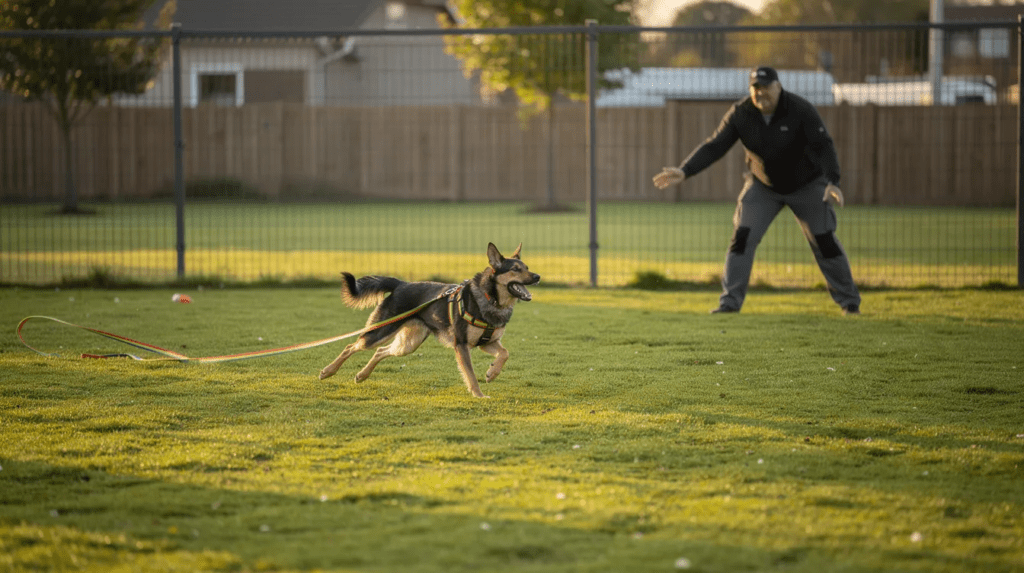
Start in a quiet fenced area, such as a yard or enclosed community space. Use a standard leash first, then a 20 to 30-foot-long line. Many handlers utilize a 30-foot to 50-foot training lead before unclipping a leash because it provides a safety net while practicing distance commands.
A safe progression looks like this:
| Step | Goal | Example |
| Leash work | Build control close to you | Heel, sit, down, recall |
| Long line | Add distance safely | Come from 20 to 30 ft away |
| Drag line | Test choices with backup | The dog drags the line in a fenced area |
| Secure off-leash | Short freedom with control | Brief sessions in enclosed spaces |
| Distraction proofing | Build reliable obedience | Parks, patios, trails, and sidewalks |
Off-leash dog training requires a step-by-step progression from close control to carefully managed freedom in secure, legal environments. The goal is a reliable response around distractions, not unlimited freedom. Some training may also include boundary awareness, which helps a dog learn to stay within a safe working distance of the handler instead of wandering too far before being called back.
Practice recall, sit, down, stay, and place at increasing distances. Add mild distractions first, such as family members walking by, toys on the ground, or a door opening. Distraction proofing involves gradually introducing stimuli in controlled environments, starting from a fenced yard and then moving to leashed practice in public settings such as sidewalks, parks, patios, and trails where dogs are allowed.
Then add Phoenix distractions slowly:
- Bikes and joggers on canal paths
- Other dogs at local parks
- Kids playing ball
- Restaurant patios
- Desert wildlife and trail traffic
Training programs that focus on obedience often emphasize distraction-proof training because dogs need to learn commands in more than one environment. Start where your dog can succeed, then slowly increase difficulty as your dog becomes more consistent.
Keep training sessions short and frequent. Five to fifteen minutes is often enough. Heat management is important for outdoor training, recommending morning or evening sessions to avoid intense heat and ensuring adequate hydration. Check pavement temperature, use shade, and stop if your dog looks tired or unfocused.
Many obedience programs include e-collar training as part of a structured plan, while reward-based options such as Basic Marker Mastery™ use tools like a leash, clicker, and slip lead. When used properly, an e-collar should support clear communication between the owner and dog. It requires proper fit, timing, and instruction, and should never replace leash safety, responsible handling, or local leash laws. The goal is guidance and communication, not punishment.
Video can help too. Recording sessions like professional dog training videos lets pet parents review timing, body position, repeated commands, and missed rewards.
Common Off-Leash Training Mistakes to Avoid
Many setbacks in off-leash obedience training come from human mistakes, not a dog being “stubborn.” The dog’s behavior usually reflects the clarity, consistency, and environment of the training.
Common mistakes include:
- Rushing too soon
Unclipping the leash at a busy dog park before recall is proven on a long line is risky. - Being inconsistent
Repeating commands over and over teaches the dog that the first cue does not matter. - Training only at home
Backyard success does not always transfer to strollers, patios, kids, bicycles, and other dogs in Phoenix neighborhoods. - Overusing treats without a plan
Rewards are useful, but dogs also need praise, play, access to sniffing, and clear expectations. - Copying online methods blindly
A training technique works only when it fits the dog, handler, timing, and situation. Different training methods may be needed for puppies, older dogs, reactive dogs, or high-drive dogs. - Ignoring behavior problems
Reactivity, fear, or aggression should be addressed before off-leash work. Behavior modification techniques for dogs often involve identifying the root causes of undesirable behaviors, such as aggression or reactivity, and implementing structured training to address these issues. Effective behavior modification can include desensitization and counter-conditioning, which help dogs learn to respond differently to triggers that cause fear or aggression. Training programs that focus on behavior modification typically require consistency and patience from the owner, as well as a clear understanding of the dog’s specific behavioral issues.
A well-behaved dog still needs responsible supervision, especially in public or around distractions. The goal of training is to create clearer communication, better choices, and stronger control, not to remove the owner’s responsibility to watch and guide the dog.
When Professional Dog Training in Phoenix Can Help
Many dog owners can make good progress alone. Others benefit from a professional dog trainer who can see timing, body language, and motivation in real time.
Consider dog training services if your dog:
- Bolts when a gate opens
- Ignores the recall around other dogs
- Shows aggression, fear, or reactivity
- Pulls hard enough to cause falls
- Cannot focus outside the home
- Needs basic and advanced obedience for higher-level goals
Training options may include professional dog training services, such as private lessons, obedience programs, board and train, puppy training, behavior work, or therapy dog preparation. Board and train can help build structure quickly, while private lessons may be better for teaching owners how to handle daily routines and maintain progress at home.
Before choosing a program, ask what commands are covered, what support is included after training, how tools are used, and what follow-through is expected from the owner. Good training should improve communication, build trust, and help your dog become more reliable in real Phoenix environments.
When comparing the best dog trainers for dog training in Phoenix, ask practical questions:
- Do they offer a personalized plan?
- Do they explain tools clearly?
- Do they practice in the Phoenix area, not only inside a facility?
- Do they provide follow-up lessons or lifetime support?
- Do they have experience with training ranging from basic obedience to advanced obedience?
- Does the train program fit your dog’s personality?
Do not choose a trainer based on credentials or résumé highlights alone. Background experience can be helpful, but clear communication, safe training practices, realistic expectations, owner coaching, and results that fit your dog’s needs matter most. Ask whether the training approach is explained clearly and whether it fits your dog’s temperament, behavior, and goals.
If you want training in Phoenix, AZ, look for realistic promises, safe tool use, strong owner coaching, and practical work in real-life places. A responsible dog owner should feel informed, not pressured.

Final Thoughts on Off-Leash Obedience Training
Off-leash obedience training is a long-term goal built on leash work, basic obedience, and patient proofing around distractions. It should move from leash to long line to controlled off-leash sessions, not from backyard success straight to full freedom.
The end result is a calm, responsive, well-mannered companion that can enjoy more freedom in safe, legal settings while staying under control in Phoenix, AZ. Celebrate small wins, stay consistent, and get help if recall, focus, or listening around distractions still feel unreliable after consistent practice.
FAQ: Off Leash Obedience Training Phoenix, AZ
Here are a few common questions pet parents ask before starting off-leash obedience.
At what age should I start off-leash obedience training?
Puppies can start age-appropriate foundation work early, including name recognition, short recall, sit, down, place, crate routines, and leash handling. True off-leash practice should wait until the dog has reliable basic obedience, maturity, and focus around distractions. For young puppies, keep training safe, short, and suited to their age and vaccination status.
How long does it take to get a reliable off-leash recall?
Timelines vary based on the dog’s age, temperament, history, prey drive, distractions, and consistency at home. Some dogs make progress quickly, while others need months of structured leash and long-line practice before recall is reliable around real-world distractions.
Is it safe to let my dog off-leash on Phoenix hiking trails?
In Phoenix, treat hiking trails as leashed areas unless a posted rule clearly says otherwise. Many trails require dogs to stay on leash, and City of Phoenix hiking trails prohibit dogs when temperatures reach 100°F or warmer. Off-leash practice should be limited to secure, legal areas such as designated off-leash dog parks or enclosed private spaces.
Can anxious or rescue dogs learn off-leash obedience?
Yes, many anxious or rescue dogs can learn stronger obedience and recall skills. They often need extra time building trust, confidence, and basic obedience first. Fearful, reactive, or formerly neglected dogs may need a slower plan, professional support, and behavior work before any off-leash practice is considered.
If your dog struggles with recall, focus, leash manners, or listening around distractions, contact us to discuss the right training plan.
Contact Us
Contact us Today to discuss a training plan that fits your dog’s needs. A structured program can help you build safer control, better communication, and more reliable obedience in everyday Phoenix environments.
