
Key Takeaways
- Marker training for dogs uses a clear signal, such as a marker word, clicker, or visual cue, to tell the dog exactly which behavior earned a reward.
- Good timing, consistency, and repetition with a marker word build clear communication, a stronger focus, and more reliable dog obedience.
- Reward-based training with markers supports basic commands like sit, down, place, heel, recall, and leave it for both puppies and adult dogs.
- Dog owners should avoid late or sloppy marking, confusing body language, or rewarding the wrong behavior, because these habits slow the learning process.
- Working with a professional trainer can help build strong marker foundations, especially for reactive dogs or dogs with significant behavior challenges.
Introduction
If your dog ignores your cues, pulls on the leash, or seems confused about what you want, the problem usually is not stubbornness. It may be unclear communication. Marker training for dogs can help by giving you a simple, repeatable way to “flag” the exact moment your dog does something right, using a marker word, clicker, or hand signal paired with a reward.
This approach fits well with modern positive reinforcement dog training. Instead of relying on corrections or hoping your dog figures it out, you use timing, consistency, and a clear sound or word to tell the dog which behavior you like. Marker training can make communication clearer and help dogs understand behaviors that might otherwise feel confusing.
In this article, you will learn how marker training works, which obedience skills benefit most, what mistakes to avoid, and when professional dog training support can make a real difference.
What Is Marker Training for Dogs?
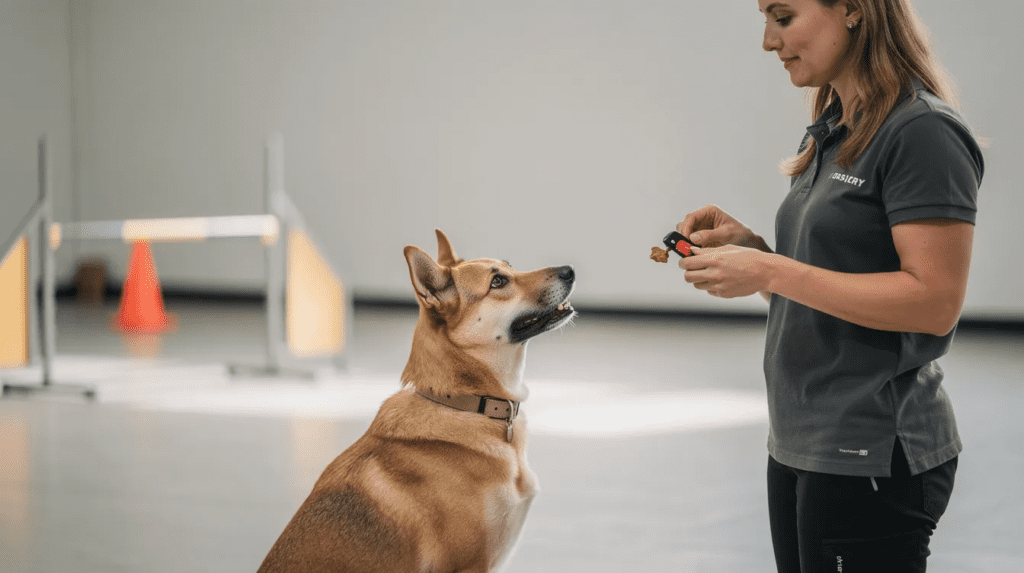
Marker training is a form of reward-based training where a specific word or sound marks the exact moment the dog performs a desired behavior. A marker word tells the dog what behavior earned a reward, acting like a verbal snapshot of the correct action. The marker itself is not the reward. It is a promise that a reward is coming.
At first, the marker is a neutral signal. Your dog does not care about the word “Yes” or the sound of a clicker any more than it cares about any other random noise. The marker becomes meaningful only after you pair it with something the dog values, like a food treat, toy reward, or enthusiastic praise. This conditioning phase is sometimes called “charging” the marker, and the number of repetitions needed can vary by dog, reward value, and training environment.
Common marker words include “Yes,” “Good,” or another short word that stands out from everyday speech. Clicker training uses the same basic idea, but with a small handheld device that makes a consistent clicking sound. Some trainers also use structured marker systems with different markers for different purposes. In each case, the marker tells the dog exactly which behavior earned reinforcement.
It is important to understand the difference between a marker and other cues:
| Signal | Purpose | Example |
| Positive marker | Tells the dog the behavior was correct and a reward is coming | “Yes!” or a click |
| Duration marker | Tells the dog to keep holding the current behavior | “Good” (sustained tone) |
| Negative marker | Indicates a mistake without punishment | “Nope” or “Eh-eh” |
| Release word | Tells the dog the exercise is finished | “Okay” or “Free” |
| Verbal cues | Commands that ask for a specific behavior | “Sit,” “Down,” “Come” |
A negative marker is not a correction. It simply tells the dog that the current behavior will not earn a reward, allowing the dog to try something else. This keeps the training process positive and productive.
Marker training is rooted in learning theory and positive reinforcement, where animals learn from clear consequences. Over time, trainers have used marker signals with many species, including companion dogs, because they help identify the exact behavior being rewarded. Today, marker training is commonly used for basic obedience, trick training, dog sports, and improving communication between handlers and their dogs.
Behavior modification also uses positive reinforcement techniques. For puppies and sensitive dogs, especially, this approach builds confidence because the dog learns through success rather than through avoidance of corrections.
How Marker Training Builds Clear Communication
Dogs do not understand sentences. They respond to patterns, sounds, and consequences. When you layer long verbal explanations on top of inconsistent body language, the dog is left trying to decode a mess of mixed signals. A marker word or clicker cuts through all of that noise.
The Camera Shutter Effect
Think of the marker as a camera shutter. It captures the exact moment of the correct behavior, freezing it in the dog’s mind even if the food reward takes another second or two to arrive. For example, if you say yes the instant your dog’s elbows hit the ground during a down, the dog links “elbows on the floor” with “reward incoming.” Without a marker, you might fumble for a treat, and by the time you deliver it, the dog has already stood up. Now the dog thinks standing earned the treat.
This is why marker training works so effectively. It lets you separate the moment of correct behavior from the moment of reward delivery without losing clarity.
Why Timing Is Everything
The marker should be delivered as close as possible to the behavior you want to reinforce. Research on detection dogs suggests marker training can improve training efficiency in tasks where there is a delay between the correct behavior and reward delivery, but results can vary depending on the task, trainer, and dog. The practical goal is simple: mark the exact behavior you want, then follow with a reward so the dog understands what it earned.
If you mark too late, the dog may connect the marker with whatever it was doing after the desired behavior, like sniffing the ground or turning its head. Aim to mark clearly, then follow with a reward so the dog understands which behavior earned reinforcement.
Consistency and Repetition
For the marker to stay powerful, follow these principles:
- Always use the same marker word or sound. If you say the word yes during training, do not switch to “Yep” or “Nice” randomly.
- Keep your tone consistent. A marker word should sound the same whether you are calm at home or excited at the park.
- During early training, follow every click or marker with a reward so the signal stays meaningful. As the dog understands the skill, rewards can be adjusted carefully, but the marker should still remain clear and valuable.
- Repeat the pattern hundreds and eventually thousands of times. Repetition builds reliable associations.
Helping Distracted and Reactive Dogs
Clear markers can help reactive or easily distracted dogs tune in to the handler when used as part of a thoughtful training plan. In busy environments, a marker word can help identify and reward small moments of focus, calm behavior, or disengagement from a trigger. Reactive dogs often need gradual exposure, distance, management, and professional guidance in addition to marker training.
Obedience Skills That Benefit From Marker Training
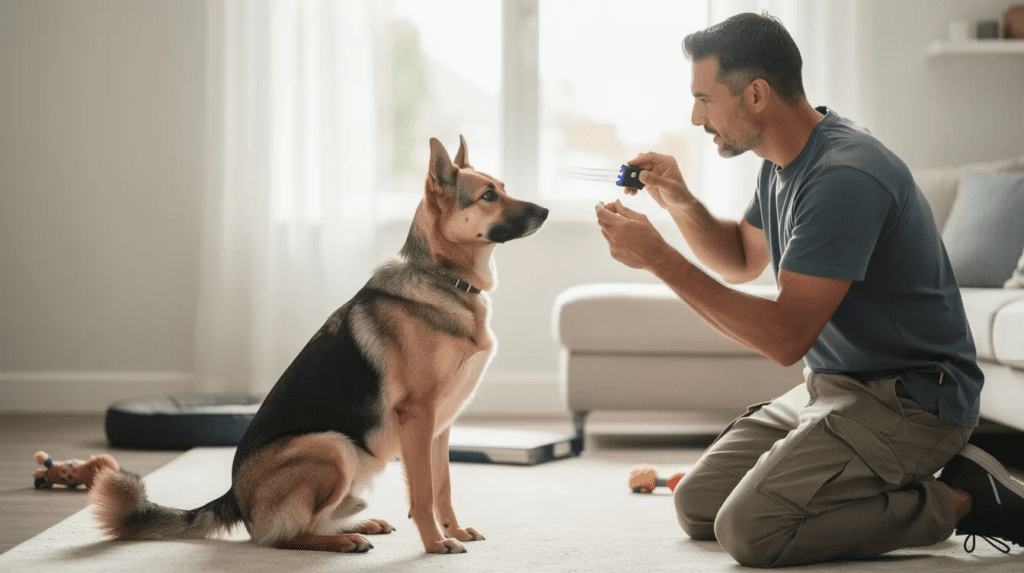
Marker training is not limited to party tricks or competition routines. It is one of the most practical training techniques for everyday dog obedience and house manners. Here is how to apply markers to the skills most dog owners care about.
Sit, Down, and Stand
- Mark the instant the dog’s hips touch the ground for a sit. If you wait until the dog is already fidgeting or shifting, you have marked something else entirely.
- For a down, mark the moment the elbows and belly are on the ground. Most dogs try to pop back up quickly at first, so sharp timing makes all the difference.
- For a stand, mark when the dog moves from a sit or down into a standing position with all four feet planted.
The goal is to mark the correct position, not the movement before or after it.
Place Command
The place command teaches a dog to go to a specific spot, like a mat, bed, or raised cot, and stay there calmly.
- Mark the moment all four paws land on the designated surface.
- Once the dog understands “get on the place,” begin using a duration marker like the spoken word “Good” to tell the dog to keep holding position.
- The release command signals the dog that it can leave the spot.
This skill is especially useful for managing behavior during meals, doorbell rings, or when guests arrive. For a deeper look at building reliable basic and advanced obedience skills, structured training can help owners practice the process more clearly and consistently.
Heel and Loose Leash Walking
Heel work is one of the harder skills to teach because so many things compete for the dog’s nose and attention.
- Mark when the dog is in the correct position at your side, with the leash slack.
- Mark moments of eye contact while walking, rewarding the dog for checking in with you rather than pulling toward distractions.
- If the dog moves ahead or drifts wide, simply stop and wait. When the dog returns to the correct position, mark and reward.
Active dogs try to engage their handlers for rewards when they understand the marker system. Instead of dragging you down the street, the dog starts looking up and offering focus because it knows that position earns something valuable.
Recall
Recall may be the single most important obedience skill, and it is also one of the hardest to prove against distractions. Marker training helps in two stages:
- Mark the moment the dog chooses to turn toward you after hearing the recall cue. This is the critical decision point.
- Mark again (or reward directly) when the dog reaches you.
By marking the turn, you reinforce the decision to come back, not just the act of arriving. This distinction matters enormously in off-leash or long-line training, where the dog has the freedom to ignore you.
Impulse Control: Leave It, Stay, and Wait
Impulse-control skills require the dog to resist doing something it wants to do, which is hard for many dogs. Markers make the rules clear:
- For leave it, mark the moment the dog looks away from the temptation and back at you, or the moment the dog’s nose pulls back from a forbidden object.
- For stay, use a duration marker like “Good” to tell the dog it is doing the right thing by holding still. The release word tells the dog when the exercise is over.
- For waiting at doors, curbs, or before meals, mark the pause and calm behavior rather than the frantic excitement.
These reward-based foundations with markers can support more advanced obedience, including better focus around distractions. When you can mark precise moments of self-control, the dog learns that patience and calm behavior are worth repeating.
Why Marker Training Helps Puppies, New Dogs, and Basic Manners
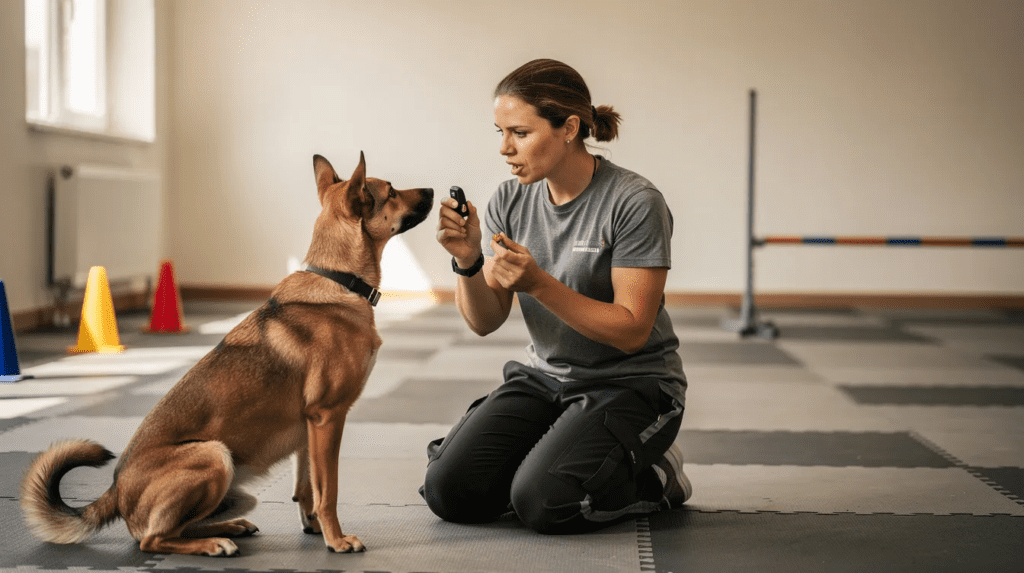
Marker training is ideal for young puppies, recently adopted dogs, and dogs that are brand new to structured dog training. These dogs often have no framework for understanding what humans want, and markers give them a fast, low-stress way to start learning.
Puppies and Short Attention Spans
Puppies have notoriously short attention spans. They bounce from one thing to the next, and traditional methods that rely on sustained focus often fail. Marker words let pet owners reward quick moments of calm behavior, eye contact, or a brief sit before the puppy moves on to something else. Even a two-second sit that earns a click and a food treat teaches the puppy that stillness pays.
Training sessions should be fun to maintain dog engagement, and dogs need to feel like playing to engage effectively. For puppies, this means keeping sessions under five minutes and ending before the puppy loses interest. Training sessions can last longer if the dog is engaged, but with very young dogs, shorter is almost always better.
Training sessions should end on a positive note for dogs. If your puppy nails a simple sit or a brief moment of eye contact, mark it, reward it, and stop there. Ending on success builds a puppy that looks forward to the next session instead of dreading it.
For guidance on starting young dogs off right, a qualified trainer can help you set up a clear marker foundation and show you how to practice short, successful sessions at home.
Rescue Dogs and Rebuilding Trust
Rescue dogs or newly rehomed adult dogs often arrive with mixed experiences. Some have never been trained. Others have been corrected inconsistently or harshly. Clear, reward-based markers can rebuild trust and help these dogs feel safe trying new behaviors. When a dog learns that a specific word or sound always leads to something good, it starts to relax and experiment. Dogs find security in predictable patterns, and that predictability is exactly what marker training provides.
Common Manners That Benefit From Markers
Many trainers use markers to teach the everyday manners that make life with a dog smoother:
- Polite greetings without jumping on guests
- Sitting before the doors open
- Waiting at curbs before crossing streets
- Walking on a loose leash without pulling
- Settling on a mat or bed when asked
- Not counter-surfing or stealing food
Each of these skills involves a clear moment that can be marked: the pause before the door, the four-on-the-floor greeting, or the glance back at you instead of lunging toward another dog. When you give your dog precise feedback at those moments, the learning process becomes clearer and easier to repeat.
Common Marker Training Mistakes to Avoid
Even small handling errors can slow progress, but most mistakes are easy to fix once you notice them. Here are the ones that trip up many dog owners.
Late or Sloppy Timing
The most common mistake is marking too late. If the dog sits and you say yes half a second after the dog has already started to stand back up, you just marked the stand, not the sit. The dog makes an association with whatever it was doing at the moment of the mark, not what you intended.
Dogs should receive clear feedback as close to the desired behavior as possible. If you consistently mark too late, you may accidentally reinforce something else. Good timing is a skill that improves with practice, just like any other physical coordination.
Using the Marker as General Praise
If you say yes every time your dog does anything vaguely pleasant, the word loses its precision. The marker should stay reserved for behaviors you are actively training. Saying “good boy” when your dog is lounging on the couch is fine as praise, but it should not be the same word you use as your reward marker during a training session.
The difference matters. Praise is general encouragement. A marker is a precise tool that tells your dog exactly which behavior you are reinforcing. When you blur that line, the dog stops treating the marker as meaningful.
Confusing Body Language
Reaching for your treat pouch before you mark is one of the most common body language errors. When your hand moves toward the treats first, the dog watches the hand instead of focusing on the behavior. The dog learns to follow the motion of your hand rather than listening for the marker word.
Other mixed signals include:
- Leaning forward before marking, which can cue the dog to move toward you
- Pointing or using a hand signal at the same time as the marker, which can overshadow the sound
- Tossing the treat before the mark, which turns the food into a bribe rather than a reward
Using a marker helps prevent bribing the dog with treats because the food stays hidden until after the mark. The dog works for the information the marker provides, not for the sight of food in your hand.
Rewarding Overexcited or Pushy Behavior
If your dog barks at you, jumps on you, or grabs at food and you mark any of those moments, you are reinforcing exactly the behavior you want to eliminate. If the dog responds to training with frantic excitement, pause. Wait for a breath of calm. Then mark the calm moment.
Using varied rewards can enhance a dog’s emotional state. For some dogs, a calm spoken word and a gentle food reward work better than an excited delivery that amps the dog up further. Match the energy of the reward to the behavior you want to see more of.
How to Sharpen Your Timing
Encourage yourself to practice before working with the dog. Here are a few simple drills:
- Watch a video of a bouncing ball and try to say yes each time the ball hits the ground. Notice how often you are early or late.
- Have a friend drop a tennis ball and practice marking the exact moment it contacts the floor.
- During a training session, record yourself on video and review where your marks fall relative to the dog’s behavior.
Good timing is a mechanical skill. The more you practice, the more automatic it becomes. Sharper timing can make your training clearer and help your dog understand what you want more easily.
Switching Between Different Markers
Some trainers use different markers for different purposes, such as a clicker for new behaviors and a spoken word for maintenance. This can work well if you are consistent, but switching randomly between markers without a system confuses the dog. Pick a system, learn it, and stick with it.
When Professional Training Can Help
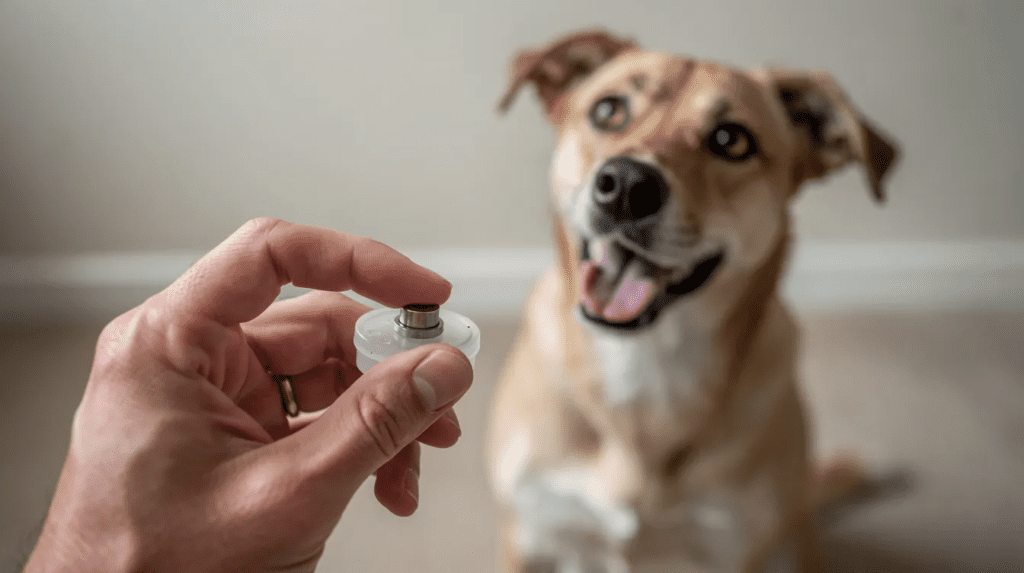
Many dog owners can start marker training at home with a treat pouch, a clear marker word, and a few minutes of daily practice. But some dogs and situations benefit from professional guidance that goes beyond what a YouTube video or blog post can offer.
When to Seek Help
Consider working with a professional trainer if you are dealing with:
- Reactive dogs that lunge, bark, or shut down on walks may need carefully designed training plans that combine marker training with management, desensitization, and counter-conditioning. A qualified trainer can help build safety and structure around these challenges.
- Dogs with a history of aggression toward people or other dogs, where timing errors carry higher consequences.
- Very strong, energetic dogs that overwhelm their owners physically, making it hard to practice calmly.
- Dogs that seem to “know” commands at home but fall apart in distracting environments.
What a Professional Adds
A skilled trainer can fine-tune your timing in real time, showing you exactly when to mark and helping you feel the rhythm of good timing versus late marking. They can also help you match reward value to the dog. High-value treats keep dogs engaged during training, but the right reward depends on the individual dog. Some dogs find a piece of chicken irresistible. Others light up for playing tug or chasing a ball.
Professional support can also help with structured progression. Moving from basic marker work in the living room to reliable obedience in a busy park requires a step-by-step plan, careful timing, and practice across different environments.
Getting Unstuck
If you feel stuck, frustrated, or unsure whether you are rewarding the correct behavior, that is a sign to get help. Even a single session with a qualified trainer can reveal patterns you cannot see on your own, like a body language habit that is confusing your dog or a timing gap that is reinforcing the wrong moment.
A consultation with a qualified trainer can help you evaluate where your marker training foundation stands and what steps to take next.
Final Thoughts
Marker training for dogs is not complicated, but it does require intention. A simple marker word, paired with well-timed food rewards or dog treats, can make everyday training clearer and more consistent. From puppies learning sit to adult dogs practicing recall and place, the same principles apply: mark the behavior you want, reward it quickly, and repeat until the dog understands what earns reinforcement.
Patience, timing, and consistency matter more than perfection. You do not need flawless technique from day one. Even small improvements in clarity, like tightening your timing or keeping your hands still until after the mark, can help your dog learn more easily over time. The training process is a conversation, and markers give you a shared language that both you and your dog can rely on.
If you want stronger obedience foundations, better focus around distractions, or help with challenging behaviors, consider reaching out to a professional trainer who can evaluate your dog, sharpen your technique, and build a plan that fits your goals.
FAQ
How do I choose the best marker word for my dog?
A good marker word is a short word or sound that you do not use in everyday conversation. Many trainers recommend “Yes” because it is quick and easy to deliver with a consistent tone. You could also choose a word like “Nice” or “Yep,” as long as it does not sound like other commands or your dog’s name.
Say the word the same way every time. Avoid shouting it when excited or mumbling it when tired. The consistency of the sound matters just as much as the word itself. When you say yes during training, it should sound identical whether you are in the kitchen or at the park.
Do I always have to use food rewards with marker training?
Food rewards or soft dog treats are usually the easiest way to start marker training, especially when teaching new skills or working in distracting environments. Food is fast to deliver, easy to control, and motivating for most dogs. A small, soft food treat that the dog can swallow quickly keeps the training session moving.
Once the dog understands the marker and reliably performs a behavior, you can gradually mix in other rewards. A toy reward, a game of playing tug, or enthusiastic verbal praise can all serve as reinforcement. Over time, you can move toward a variable reward schedule for well-known behaviors, where the dog does not receive a treat every single time but still performs reliably because the marker remains an effective tool.
Can marker training work for older dogs or only for puppies?
Marker training is effective for dogs of all ages, including senior dogs. Older dogs may need slightly slower sessions, smaller and softer treats, and more patience during the early conditioning phase. But the principle is the same: a clear marker paired with a valued reward helps the dog understand what you want, regardless of age.
For older dogs, focus on calm behaviors, gentle movement, and mental engagement rather than high-impact activities. Short sessions of two to three minutes, repeated a few times throughout the day, can produce steady progress without overwhelming an older dog’s energy or joints. Many dogs who never received formal training in their younger years thrive with marker work later in life because the method is low-pressure and reward-focused.
Is a clicker better than a marker word?
Neither is universally better. A clicker produces a consistent, distinct sound every time, which some handlers find easier for precise timing. A marker word can vary with tone, stress, fatigue, or background noise, but it is always available and does not require equipment. The best choice is the one you can use clearly and consistently.
A marker word like “Yes” is always available. You do not need to carry anything extra, and you can use it in many real-life situations, from walks to door greetings to park visits. Some trainers start with a clicker for precision during early learning and then transition to a spoken word once the dog understands the concept. Either way, the important thing is that the sound remains distinct, consistent, and clearly connected to reinforcement.
How long does it take to see results with marker training?
Many dogs start to understand the marker and show small improvements within a few short sessions when timing and rewards are consistent. You might notice your dog’s ears perk up at the marker word, or see the dog begin to offer behaviors like a sit without being asked. These early signs of problem-solving indicate that the dog is connecting the marker to its own actions.
Building more reliable obedience around distractions, such as recall or calm behavior near other dogs, takes longer and benefits from a structured training plan and regular practice. For complex goals like off-leash work or calm behavior in busy environments, expect gradual progress across increasingly challenging settings.
